
Historical Context
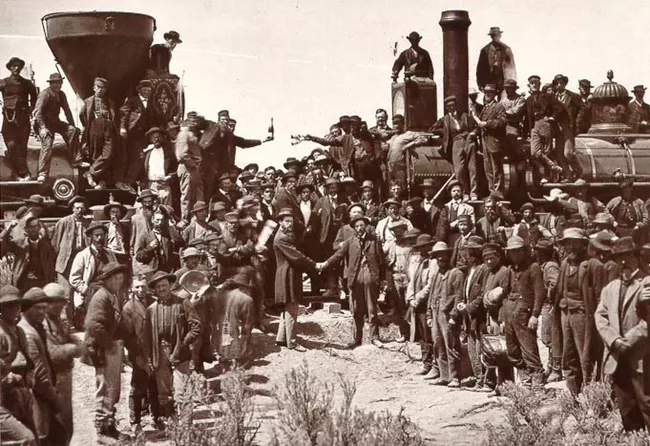
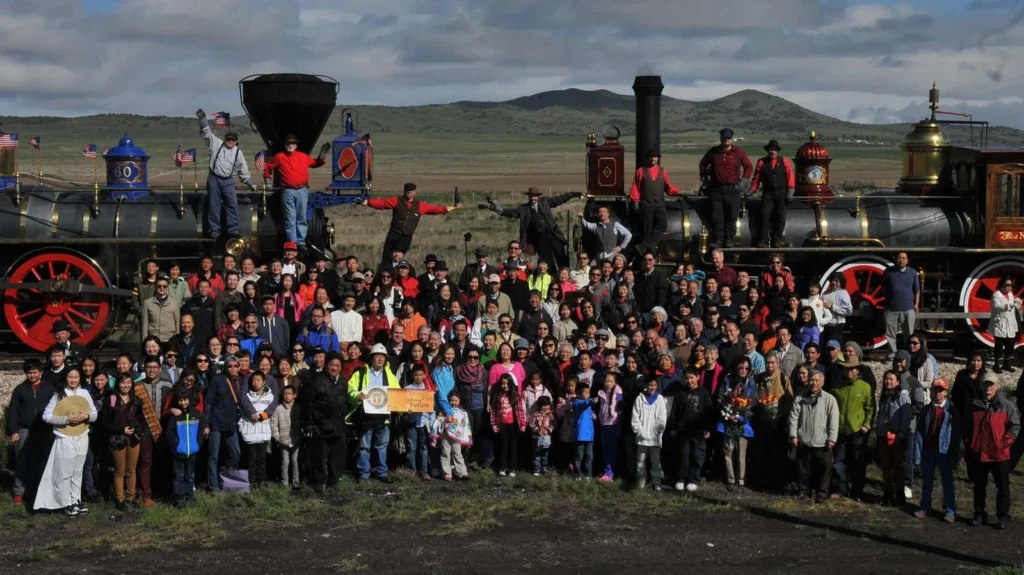
The courageous labor of Chinese workers on the Central Pacific Railroad (CPRR) is one of the best-known episodes in Asian American history. From 1864 to 1869, they constructed tunnels in the Sierra Nevada and Rocky Mountain ranges and laid tracks. Given incomplete and inexact records, it is impossible to know the total number of Chinese laborers who worked on this project. In the later years of construction, historians estimate that between 10,000 and 15,000 Chinese laborers worked on the railroad at any one time. Life was perilous for these workers. Estimates of Chinese laborers who died working on the CPRR vary greatly, but many historians conclude that the number is over a thousand. They also worked longer hours and received a smaller salary than White railroad workers. One important symbol of anti-Chinese discrimination is the official photo of the “Great Spike” ceremony at Promontory Summit, Utah, where the western section of the CPRR connected with the eastern section. Even though the western section was built primarily by Chinese workers, they were not allowed to be in the photo.
The plight of Chinese railroad workers has inspired numerous artists of many disciplines. In “We Are the Children,” the anthem of the Asian American movement (see #9 of this resource), songwriters Chris Iijima and Nobuko Miyamoto proclaim that we—Asian Americans—are, among other professions, the “sons and daughters of the railroad builder who leave their stamp on America.” Large-scale musical works about Chinese railroad workers include Jon Jang’s Chinese American Symphony (2006), Zhou Tian’s Transcend (2019) and Jason Ma’s musical Gold Mountain (premiered 2021). The protagonist of Ma’s musical is a “fuse runner,” one of the most dangerous jobs on the CPRR. He had to light the dynamite that bore tunnels, and—in order to survive—run out before the explosion occurred.
Dawen Wang (b. 1981), who performs as Dawen, grew up in the Boston area. He moved to Hong Kong at the age of 14, but returned to the U.S. to attend Northwestern University. His debut album, American Me, discusses the discrimination that immigrants of color in the U.S. face and expresses his pride in his Asian American identity. Like Betty Inada in the 1930s (see #6 of this resource), Dawen recognizes the difficulties Asian American popular musicians faced in the U.S. recording industry and began looking for opportunities in Asia. In 2012, he relocated to Taiwan, and has been a Universal Music Taiwan artist ever since.
The Music
“Ku Li,” the third track from American Me, is simultaneously a tribute to Chinese railroad workers, a history lesson that counters simplistic portrayals of the American Dream, and a vehicle for opening difficult conversations. The title is the international phonetic alphabet’s spelling of “coolie.” This term was originally used by European traders to denote low-wage laborers in Asia. In the 19th century, “coolie” often specifically referred to Asian contract laborers who performed jobs previously performed primarily by enslaved Africans—a definition that fit Chinese railroad workers well. More recently, “coolie” has increasingly been considered a racial slur for Asians in much of the world.
To set the mood, the song opens with a groove made up of sounds that imitate the noises workers made on the railroad. After a fairly extended introduction, Dawen sings two three-line verses. The first two lines discuss the sweat and toll of railroad work that paid a dollar a day. In the third lines, he says that, by coming to the U.S., he thought he would “find a better…” In both verses, the last word was unsaid. Did he ever have an idea of what will improve? Or is he just disillusioned? We don’t know. The chorus is set to the tune of the folk song “I’ve Been Working on the Railroad.” He begins with the standard lyrics, but soon changes them to fit his own situation. The last line reads, “Just to hear the tall man tell me I’m a…” The last word is once again delayed.
This word is eventually revealed in the groove of the bridge—it’s the anti-Chinese racial slur “ch**k.” Over these rhythms, Dawen expresses how he could never please his supervisor and how difficult the work is. To make things even worse, his experiences have largely been erased: “For if you open up the history book / You’ll find that I’m just barely even there.” After the bridge, he sings two new verses, in which he says that he has “no place in the Promised Land” because he is “not the right race.” He then repeats the chorus and the first two verses, and ends by repeating the words, “a better…” A better what? He never tells us. Does he simply not know? Does he not think anything got better? By repeating those words at the end, is he suggesting that his experience of discrimination, invisibility and exclusion is repeated over and over again in later generations? Would his descendants have a better idea of what is better? These are some of the questions he leaves us at the end of the song.
Resources
- Chinese Railroad Workers in North America Project at Stanford University
- Chinese Railroad Workers Descendants Association
- Excerpt from Eric Hung, “Songs of Chinese American Labor” (Presentation at 1882 Foundation)