
Asian America in 25 Songs
#5: Toshiko Akiyoshi Trio, “Tosh’s Fantasy”
Historical Context | The Music | Resources
Historical Context
In the 1910s, American and Filipino bands on transpacific ocean liners brought jazz to Japan, where the genre took root within a few years. Dance halls in Osaka and Kobe hired visiting Filipino jazz bands, and gave opportunities to emerging Japanese jazz performers to establish careers. By the early 1930s, the genre had spread to other urban areas, and began the process of “glocalization.” Composers, such as composers Ryoichi Hattori and Koichi Sugii, began jazzing up traditional Japanese melodies and wrote new works with Japanese themes. During World War II, the Japanese government branded jazz “enemy music,” but was never able to effectively ban it.
Upon Japan’s surrender, the Allies–led by the U.S.–occupied the war-torn country for seven years. During this period, American troops cultivated the Japanese jazz scene not only because they wanted to hear the music, but also because American popular music was used as a form of soft power that pushed Japan to transform into a modern, Western-friendly nation. Jimmie Araki (1925–91) was a Japanese American soldier who came to Japan in 1946. While he was incarcerated at the Gila River Incarceration Camp during World War II (for more about the Japanese American incarceration, see #7 of this resource), Araki studied music seriously. He played in several jazz bands and started his own combo. During his service in Japan, he was credited with introducing bebop to that country.
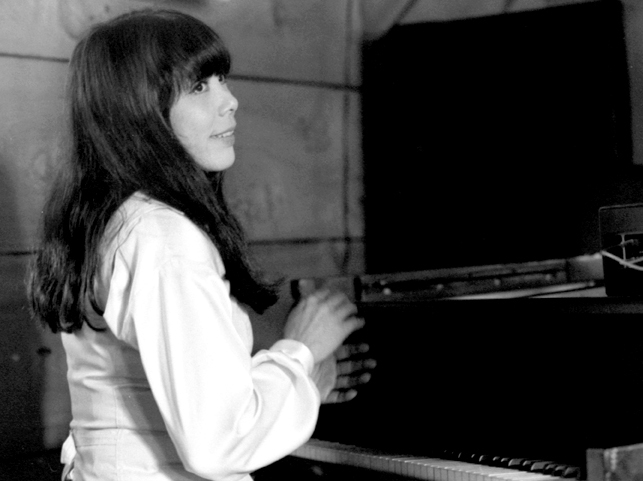
In 1948, a Manchurian-born 19-year-old jazz pianist named Toshiko Akiyoshi (秋吉敏子, b.1929) moved to Tokyo and began performing there. Oscar Peterson, who was in Japan as a member of the 1953 Jazz at the Philharmonic tour, saw one of her performances, and immediately arranged for her to make a recording with his rhythm section. This experience urged her to further her career in the U.S. In January 1956, she became the first Japanese student to attend the Berklee School of Music, which she did on a full scholarship. Soon after her arrival, she began flourishing within the almost exclusively male and primarily Black and white U.S. jazz scene. Akiyoshi was the first Japanese woman to be recorded by a major studio, Verve Records, and the first woman to win Best Arranger and Composer awards in DownBeat magazine’s annual Readers’ Poll.
The Music
In the 1930s and ‘40s, big band swing filled the airwaves. But increasingly, smaller jazz groups (e.g., trios and quartets) broke away, allowing younger jazz musicians to innovate stylistically and play with greater virtuosity. As artistic styles often do in times of societal instability, the genre began to bifurcate. Some jazz artists embraced past standards, but others looked for innovation. Sticking to a more traditional approach might have seemed an attractive and perhaps easier approach to a newcomer who looked different. But Akiyoshi, an outsider in both race and gender, embraced innovation, using her trio (composed of herself on piano, Jake Hanna on drums, and Gene Cherico on bass) to establish her forward-thinking personal style. One of the earlier compositions recorded by her trio, “Tosh’s Fantasy,” combined bebop with a new popular genre, rhythm and blues. The resulting style became known as hard bop.
“Tosh’s Fantasy” comprises three parts, which are titled “Down a Mountain,” “Phrygian Waterfall,” and “Running Stream.” Each part could function as its own song if extracted from the whole, particularly “Down a Mountain.” This first section contains several traditional characteristics of bebop: a lively tempo, a major-sounding tonality, and an extended improvisation in the middle. At the end of “Down a Mountain,” the piano shifts to a darker mood and holds a dissonant tone. This becomes the lead-in to “Phrygian Waterfall.” Here, Akiyoshi uses a five-beat groove, and employs a mode that is often associated with mystery and feelings of tension. In the final section, “Running Stream,” Akiyoshi plays jarring dissonances at breakneck speed. “Tosh’s Fantasy” demonstrates her band’s virtuosity, her knowledge and mastery of bebop, and her capacity to experiment.
Although she was able to make a living playing and writing music, Akiyoshi experienced some discomfort during her early years in the U.S. Despite having the respect of her contemporaries, reviews of Akiyoshi’s first recordings often belied a sense that some saw her–like many saw Ma and Tung (see #4 of the resource) as a curiosity, a “cute Asian,” rather than a serious performer. Nonetheless, Akiyoshi’s talent propelled her forward, and she has had a successful career spanning over fifty years. She has won prestigious jazz awards over her lifetime and has been nominated for fourteen Grammys. She recorded over eighty records, wrote around 100 compositions, and started dozens of jazz groups and ensembles; the Toshiko Akiyoshi–Lew Tabackin Big Band (co-founded with her second husband) was one of the most celebrated and successful American big bands of the 1970s and ‘80s. Akiyoshi also experimented with traditional Japanese instruments and folk melodies in her original compositions, which ultimately contributed to her winning Japan’s prestigious Order of the Rising Sun (旭日章) in 2004.
Resources
- Ken Dryden, “Toshiko Akiyoshi: Fine Wine.” (All about Jazz, May 2, 2009).
- Ally Dunavant, “Who is Toshiko Akiyoshi? Meet the Japanese Pianist and Composer Who Transformed Jazz Music.” (Classic FM, July 12, 2024.)
- Jung, Fred. “A Fireside Chat with Toshiko Akiyoshi.” (All about Jazz, April 20, 2003.)
- Renee Cho (director). Jazz Is My Native Language: A Portrait of Toshiko Akiyoshi. Center for Asian American Media.