
Asian America in 25 Songs
#8: Kim Sisters, Medley performed on The Ed Sullivan Show
Historical Context | The Music | Resources
Historical Context
During Japan’s thirty-five–year occupation of Korea (1910–45), civilians suffered social erasure, unfair wages, dangerous working conditions, sexual slavery, and heavy taxation to pay for infrastructure projects. This came to an end after the Yalta Conference in 1945. There, Stalin met with the U.S. and Great Britain, and agreed to drive Japanese forces out of Korea in exchange for control over Southern Sakhalin, the Kuril Islands, more influence in Manchuria, and recognition of Mongolian independence. Japan’s departure left a power vacuum in Korea, which was temporarily filled by two occupying forces: Soviets above the 38th parallel and the U.S. forces below it, creating a divided peninsula. Within a couple years, a low-level civil war began, and by 1950 the Korean War was officially underway. Nearly every major city in the peninsula was destroyed in the three following years. Millions of Koreans died, mostly civilians. Despite being freed of colonization and occupation, no peace treaty has been signed and the state remains split approximately along the 38th parallel, and in frozen conflict.
The Kim Sisters (김시스터즈) was formed shortly after active combat subsided. They were a South Korean vocal girl group (also called a Korean idol group) comprised of two sisters (Sook-ja “Sue” Kim, 김숙자; and Ai-ja “Aija” Kim, 김애자) and a cousin (Min-ja “Mia” Kim, 김민자). They were mentored by the sisters’ mother Lee Nan-young (이난영), who was a successful singer and actress in her teens and twenties. She was a member of an early Korean girl groups, the Jeogori Sisters, a little over a decade before she formed The Kim Sisters. Despite her success, she faced problems feeding and housing her family after 1950, when her husband and the sisters’ father, Kim Hae-song, was killed by North Korean soldiers and their home was destroyed by a bombing. Lee turned to a familiar strength for financial support: music. She and her children performed for soldiers in exchange for items she could trade for rice and other foodstuffs. Recognizing the especially high aptitude Sue, Aija, and Mia had for music, Lee created The Kim Sisters. After familiarizing herself first with American records procured on the black market, Lee taught The Kim Sisters American popular songs and standards made famous by white girl groups like The McGuire Sisters and The Andrews Sisters (later, The Kim Sisters would sometimes be referred to as The Korean Andrews Sisters). Her song selections made The Kim Sisters appealing to homesick American G.I.s. The girls became so successful that they attracted the attention of an American producer, who signed them and helped them get a visa. The South Korean president, Syngman Rhee, personally endorsed The Kim Sisters as cultural ambassadors and encouraged them to help improve relations between the U.S. and South Korea.
Once in the U.S., The Kim Sisters spent time performing at different Las Vegas casinos. The first was the Thunderbird Hotel, where they were part of The China Doll Revue and could boast being the first South Korean music group to perform in the U.S. after the Korean War. The China Doll Revue audiences were promised Asian showgirls, “direct from So[uth] Korea, Japan, Honolulu, Hong Kong, and Macao!” In the following few years, The Kim Sisters performed at other Las Vegas hotspots including the Hilton and the Stardust. Their continued popularity in Las Vegas led to several late-night show invitations. Most notably, The Kim Sisters performed on The Ed Sullivan Show twenty-two times.
The Music
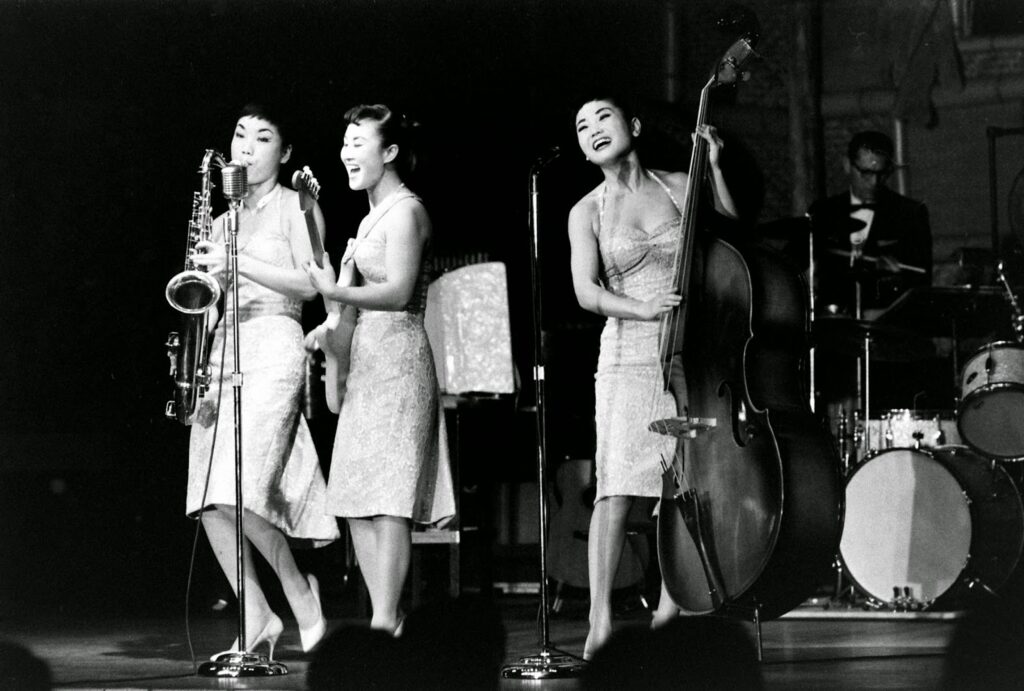
At their Ed Sullivan Show performance on January 27, 1963, The Kim Sisters sang–in English–a medley of three songs: “Five Foot Two Eyes of Blue (Has Anybody Seen My Girl?),” “Baby Face,” and “Bye Bye Blues.” All three songs were well-known American jazz standards written in the 1920s. When The Kim Sisters sang songs like these at American G.I. clubs in South Korea, they engendered comfort and nostalgia; on The Ed Sullivan Show, these tunes not only made The Kim Sisters more palatable to American viewers, but also showed the stereotype of the unassimilable Asian to be a lie.
The Kim Sisters could sing a variety of vocal styles, but for this performance, they employed a Swing Era–style of singing: strong tones, close harmonies, and tight rhythms. In “Five Foot Two Eyes of Blue,” one of the sisters briefly uses a gravelly tone, scatting an intro into a banjo solo. This was something of an Easter egg for regular viewers; the vocal technique was made popular by Louis Armstrong, who The Kim Sisters met on their first Ed Sullivan appearance in 1959. More importantly, adding a jazz singing technique further signified their knowledge of the American musical landscape. In using these singing techniques, The Kim Sisters were drawing a comparison between themselves and their American counterparts who sang in a similar fashion. They also followed in the footsteps of Japanese Americans interned during World War II, who performed swing music in the camps to prove that they can be fully American. In addition to their singing ability, The Kim Sisters were extremely talented multi-instrumentalists. On this television appearance, they played banjo with great proficiency and virtuosity. This communicated to the audience not only their musical prowess, but their valuing of an instrument associated with Americana music. Beyond that, their mastery of so many different instruments suggested that they had time for little else but practicing.
The original lyrics of two of the three songs, “Five Foot Two” and “Baby Face,” reference a “turned up nose” as an indication of beauty. This is an overtly white standard of beauty sung through the voices of Korean women who, while beautiful, do not entirely fit that standard. This is probably why the Kim SIsters omitted this phrase in their rendition of “Baby Face.” It was clever to point out the differences between The Kim Sisters themselves and any white standards of beauty, as the difference made the women seem less threatening to a largely middle-aged white female audience. On this occasion, The Kim Sisters wore well-tailored matching silk cheongsams (qipaos) with embroidered dragons and sequins, which accentuated their racial difference. This was a part of their efforts to cultivate an image of being conservatively sexy (i.e., not so sexy as to be dangerous or alienating), exotic and delicate.
The Kim Sisters would occasionally refer to Ed Sullivan as “Papa” on the air. Perhaps this somewhat mitigated their sexual presence through infantilization. The use of the word “Papa” in reference to Sullivan also reinforced the “white savior” trope. The Korean War was still fresh in the minds of Americans in 1963. Not dissimilar to some other international conflicts involving the U.S. and its interventionist attitude, there was a sense that Korea needed to be saved by America. Therefore, it behooved The Kim Sisters to show a little reverence to Sullivan. Not only as women, but as Koreans, they played into the role they were expected to play: the grateful and passive (i.e., safe) foreigners. Toeing the line between coy yet innocent, capable yet docile, exotic yet familiar, The Kim Sisters’s success paved the way for Korean girl groups on the international stage. But the impact of trailblazers like The Kim Sisters stretched beyond music into the realm of American race relations. They made Americans more comfortable and familiar with Korean faces in deeply “American” contexts (e.g., swing music, The Ed Sullivan Show).
Resources
- Benjamin M. Han. “Transpacific: The Kim Sisters in Cold War America.” Pacific Historical Review 87, no 3 (2018): 473–98.
- Eric Hung and Leslie Li, “Recovering Early Asian American Voices in American Popular Music: Two Girl Groups” (AMS-Rock Hall Lecture)
- Jessica Prois. “For the Original K-Pop Stars, Survival Depended on Making it in America.” History. June 3, 2019.
- Danielle Seid. “Forgotten Femmes, Forgotten War: The Kim Sisters’ Disappearance from American Screen and Scene.” Occasional Paper Series, 38. In David G. Schwartz (Ed.), Center for Gaming Research. Las Vegas: Center for Gaming Research, UNLV University Libraries, 2016.
- Matthew Wills. “Ladies and Gentlemen, It’s The Kim Sisters.” JSTOR Daily, August 20, 2023.