
Asian America in 25 Songs
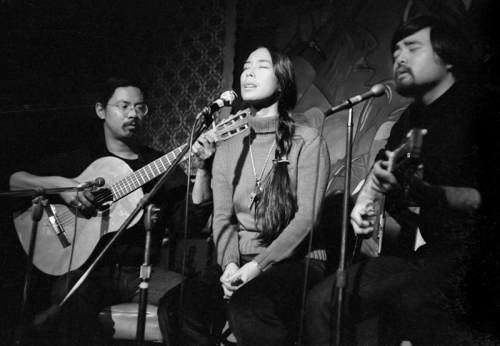
#9: Chris Iijima, Nobuko Miyamoto and Charlie Chin, “We Are the Children”
Historical Context | The Music | Resources
Historical Context
Before the mid-1960s, Asian Americans did not generally think of themselves as a single racial group. This is because people of different Asian ethnicities generally did not live together and often had very different experiences in the U.S. Most notably, while most Japanese Americans were forcibly removed to incarceration camps during WWII, the U.S. government was becoming more friendly towards Chinese Americans. It even repealed the Chinese Exclusion Act in 1943.
In the 1960s, Asian American activists participated in the Civil Rights and Anti-Vietnam War movements. Inspired by what these large coalitions could achieve, they forged what became known as the “Asian American movement.” People participating in this movement had different practical goals and visions about the future. However, almost all believed in raising Asian Americans’ political and racial consciousness, creating a pan-Asian identity based on a shared history of discrimination in the U.S., and building a multiracial coalition with other people of color. Most “Asian American movement” activists of the late 1960s and early 1970s were descendants of laborers who moved to the U.S. in the late 19th and early 20th centuries. As a result, the movement had a distinctly working-class character.
Artists played significant roles in the Asian American movement. In New York City, the Basement Workshop became a space for writers, dancers, actors and musicians to explore how artistic expression can support political and community activism. In 1972, artists there began working on an illustrated book about the songs of Chris Iijima, Nobuko Miyamoto and Charlie Chin (the musicians on this recording). This ultimately grew into Yellow Pearl, a publication that included the writing, art and music of more than thirty creators. They stated that the book is “a collection of the creative talents of young Asian Americans. It is also an expression of an emerging consciousness of being Asian in America. We need to write about the War, Attica and our people’s history. We need to express our loves, our loneliness and our dreams, through YELLOW PEARL we share what we feel, what we think, and what we are with our brothers and sisters.” In San Francisco, there is a similar organization called Kearny Street Workshop.
For better or worse, the “Asian American movement” built an Asian American identity at the very same time that Asian American communities began rapidly changing. The passage of the Hart-Celler Act in 1965 opened new opportunities for Asians to move to the U.S. Because the bill gave priority to skilled workers, many of the new immigrants are highly educated and from affluent families. In the second half of the 1970s, approximately 300,000 Southeast Asians came to the U.S. as refugees. Together, these newcomers transformed and diversified the class profile, racial makeup and life experiences of Asian American communities. Over the past half century, Asian Americans have had vigorous debates about the continued relevance of a racial identity that was created when the communities were very different.
The Music
The Asian American movement inspired music-making in many genres, including taiko, jazz, and various types of fusion (see #10 of this resource). It is, however, most closely associated with the folk revival, and particularly the 1973 album A Grain of Sand by Chris Iijima, Nobuko Miyamoto and Charlie Chin. Widely acknowledged as the first Asian American album, the twelve songs on this LP cover everything from Asian American identity to imperialism, from solidarity with Latinos to the evils of capitalism, and from Black liberation to Asian American empowerment. In terms of sound, the trio’s folk style is inflected with elements of soul, blues and jazz.
Iijima was the son of two activists. His father was a choirmaster who brought his children to the 1963 March on Washington, and his mother was the founder of Asian Americans for Action, a youth organization inspired by the Black Panthers’ educational and cultural activities. Meanwhile, Miyamoto began her career as a dancer in ballet and in film and Broadway musicals. Recognizing the limited opportunities for Asians in the American entertainment industry, she was ready for new challenges in the late 1960s. While assisting on a documentary about the Black Panthers, she met Malcolm X’s associate Yuri Kochiyama, who helped her begin her journey as a social justice activist. Miyamoto and Iijima met at a meeting of Asian Americans for Action and soon began writing music together. Their first joint show was at the 1969 Japanese American Citizens League conference. About this performance, Miyamoto said, “We sang a song that was the collective expression of our Asian brothers and sisters to stop the killing of people who looked like us. The electricity of that moment, the realization that, until then, we had never heard songs about us, set the course of my journey” (Sojin Kim, “A Grain of Sand: Music for the Struggle by Asians in America”). At an Asian American conference at Pace University in 1970, Iijim and Miyamoto met Chin, a New York-born, Trinidadian-raised multi-instrumentalist and member of the rock band Cat People & the All Night Newsboys. Chin was fluent in many musical traditions, but was searching for a style that can express his own life. Over the next few years, the three created many songs about the Asian American experience, and performed them in communities all over the country. In addition to these songs, their shows also brought news of what is happening in Asian American communities in other cities.
“We Are the Children” is often seen as the anthem of the Asian American movement. In the first two verses, the lyrics present Asian Americans as laborers who helped to build the U.S., but one line also acknowledges the anti-Asian discrimination that is so prevalent in American history: “We are the children of the migrant worker / We are the offspring of the concentration camp / Sons and daughters of the railroad builder / Who leave their stamp on America. We are the children of the Chinese waiter / Born and raised in the laundry room / We are the offspring of the Japanese gardener / Who leave their stamp on America.”
The lyrics of the third verse initially portray As Americans as fully assimilated Americans, but then reveal their capacity to critique the country’s myths and policies: “Foster children of the Pepsi Generation / Cowboys and Indians—ride, red-man ride! / Watching war movies with the next door neighbor / Secretly rooting for the other side.” In the final verse, the lyrics loudly proclaim their allegiances: “We are the cousins of the freedom fighter / Brothers and sisters all around the world / We are a part of the third world people / Who will leave their stamp on America.”
Resources
- Yosuke Kitazawa. “We Are All Part of Many Worlds: Nobuko Miyamoto’s Barrier-Breaking Art and Activism.” PBS SoCal. June 15, 2021.
- Nobuko Miyamoto (with Deborah Wong). Not Yo’ Butterfly: My Long Song of Relocation, Race, Love, and Revolution. University of California Press, 2021.
- Tadashi Nakamura. A Song for Ourselves. 2009. (35-minute documentary about Chris Iijima)
- Oliver Wang. “Between the Notes: Finding Asian America in Popular Music.” American Music 19/4 (Winter 2001), pp. 439-465.