
Asian America in 25 Songs
#12, Shoji Tabuchi, “Foggy Mountain Breakdown”
Historical Context | The Music | Resources
Historical Context
Bluegrass grew primarily out of the old-time tradition, but contains elements from many other genres, including blues, jazz, Western swing, and British folk music. These genres came to rural Appalachia largely through the new medium of radio. Kentucky-based Blue Grass Boys started out as an old-time group, but the band developed such a singular sound that they became known as the first bluegrass group. This new sound emerged after two new members joined in 1945—Lester Flatt (rhythm guitar) and Earl Scruggs (banjo). Scruggs’s three-finger picking style became one of the unique characteristics of bluegrass. Another major element is the virtuosic blues-inspired solos performed during instrumental breaks. Bluegrass fiddling grew to have its own, distinctive techniques, such as sliding into notes from below; and using “chop chords” (muted, short or clipped chords) on beats 2 and 4, which helps keep tempo in a genre that is often performed without a percussion section. This, in particular, differed greatly from old-time fiddling, where a fiddle line might be played without a steady tempo.
In 1942, the U.S. military established the Far East Network (FEN), primarily for homesick G.I.s serving in Japan, Guam and the Philippines. The station, which played a variety of American popular genres, also attracted many local audiences. Because FEN played early bluegrass, a large Japanese fanbase for the new genre emerged, and Japanese bluegrass groups began forming in the late 1950s, starting with the East Mountain Boys in 1957. This is how Shoji Tabuchi (1944-2023), a young man trained in classical violin and in college studying economics, came to hear bluegrass. He was so enamored that in 1967 he gathered $600, abandoned his degree, and pursued bluegrass fiddling in the U.S.
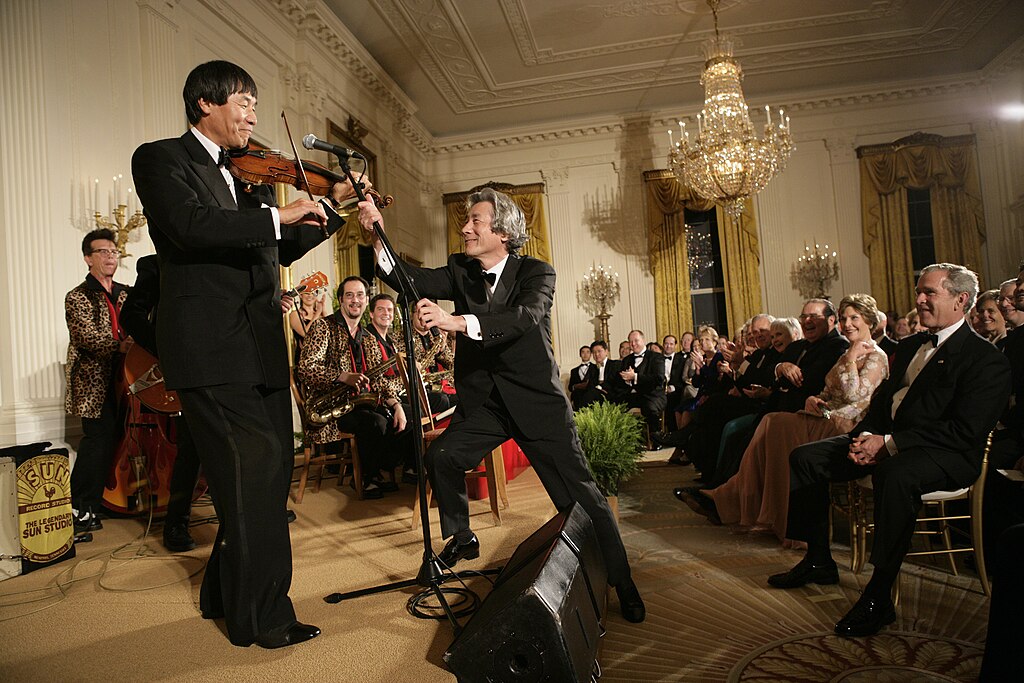
Tabuchi quickly made a name for himself in the country music scene. He performed at the Grand Ole Opry twenty-seven times, a tremendous accomplishment. He also toured as an opener for country singer David Houston in the early 1970s and collaborated with major country music stars like Dolly Parton and Conway Twitty. Tabuchi was a draw, something of an oddity as a Japanese American man amidst a genre consisting almost entirely of white performers, but his musical talent kept audiences enthralled. In 1980, his success led to a six-month residency offer from the Starlite Theatre of Branson, Missouri, which Tabuchi took. The residency was profitable and popular, and thus repeatedly extended; he spent years performing at Starlite while Branson grew to be a live-music mecca. Eventually, Tabuchi realized he could make more money if he ran his own show. He purchased his own theater, and his wife Dorothy Lingo decorated it with such lavishness as to make the spot a popular tourist attraction. Tabuchi also wanted to imbue his acts with a sense of professionalism. He kept a full orchestra employed at his theater, insisting that all his musicians wear tuxedos and have music degrees (conditions not required of special guests). By the mid-1990s, The Shoji Tabuchi Show was making millions annually. Tabuchi continued to perform traditional bluegrass music, but he added a wide array of other music genres to his shows, including rock, rap, jazz, showtunes, gospel, and taiko drumming.
One of the more surprising impacts Tabuchi had over his decades-long career was bridge-building between Japanese Americans and white World War II veterans. In some cases, Tabuchi was the first Japanese American person a WWII veteran saw in person. People would write or approach Tabuchi, thanking him for helping them overcome war-born prejudices. This is a good example of how experiential education can make inroads, reaping positive social benefits.
The Music
Since starting The Shoji Tabuchi Show, the violinist spent most of his year performing at his venue, often twice daily. But during his “off-season,” he visited and performed at other American live-music hot spots. Here, he played the standard “Foggy Mountain Breakdown” at the Ray Stevens CabaRay Showroom in Nashville. This is a classic bluegrass tune written by Earl Scruggs, the originator of bluegrass’s three-finger–picking style. The melody is introduced by the banjo and fiddle; afterwards, individual members of the band perform solos during the breakdown on lap steel (slide) guitar, piano, and banjo; to close, the fiddle reintroduces the original melody. “Foggy Mountain Breakdown” is generally performed, as is the case here, at a fast pace that showcases performers’ technical abilities. Tabuchi uses several traditional bluegrass fiddling techniques, including chop chords and virtuosic improvisation of the melody.
Tabuchi did not regularly appear on radio or make recordings on big labels. His fame and fortune were earned through his live performances, which meant that his audiences almost always saw him. Although he pointed out similarities between Japanese and American cultures in his show banter, he did not downplay his racial difference on stage. Nevertheless, this very traditional performance of “Foggy Mountain Breakdown” demonstrated that an outsider was able to completely “assimilate” into a genre that values authenticity. Through this performance, he refuted the stereotype of the Asian as an unassimilable and inscrutable perpetual foreigner. At the same time, it raised many other questions: was he able to do this because he was a “model minority”? What are the shared experiences that make someone an authentic bluegrass performer? Does the answer have to do with race, place, or economic status–maybe a combination of all three? Who decides what an authentic performance looks like? Can authenticity be achieved outside of the original time and space within which the original genre was most often performed, given that context changes performance? Music genres are constantly changing; at what point in development can we identify the moment a genre reaches its peak development? Ultimately, in the case of Shoji Tabuchi and “Foggy Mountain Breakdown,” was authenticity achieved?
However you answer the above questions, it is clear that Tabuchi put significant effort into meeting the musical expectations of his white bluegrass-loving audiences, and that seemed enough for them. They accepted, was entertained by, and celebrated an outsider who learned their culture.
Resources
- “About the Show.” The Shoji Tabuchi Show.
- S.J. Feehan, “Bluegrass in Japan: How America’s Liveliest Genre of Roots Music Found a Second Life on the Slopes of Mt. Fuji.” Mike and Mike’s Guitar Bar (blog), August 27, 2025.
- Tim Kagy, “King of Branson: Shoji Tabuchi’s Dazzling Shows Have Turned Country and Western Fans Colorblind.” Goldsea.
- “The Model Minority Myth.” The Practice, Special Issue: Asian Americans in the Law, November/December 2018.
- “Tabuchi, Shoji.” Encyclopedia.com (accessed January 7, 2026).