
Second Wednesday Webinar Series
September 9, 2026: Creating Cross-cultrual Belonging through Music
Introduction & Registration | Abstract | About the Speaker
Introduction & Registration
In this webinar, two scholars will discuss ways Hokkien and Lao communities in the United States create cross-cultural accessibility, understanding and belonging through music. First, New York-based composer Yiqi Guo explores Pe̍h-ōe-jī (Romanized Hokkien) as a medium of musical transmission and cross-cultural accessibility. Afterward, Zechary Phouthavong (UNC-Chapel Hill) examines how Lao Americans in Texas, California and Tennessee construct identity through music and performance at Lao New Year festivals. Allan Zheng (University of Pennsylvania) will serve as the moderator.
Date and Time: Wednesday, September 9, 2026, 7-8:30pm ET / 4-5:30pm PT
Register here!
This webinar is a part of the 2026 edition of MAARC’s biannual festival. Entitled “Amplify! A Festival of Asian American Music, Sound and Scholarship,” it consists of five Second Wednesday webinars (from July to November) and an in-person festival in Chicago from Sept. 24 to 26.
Abstracts
Yiqi Guo: “Transnational Musical Exchange and Community Building through Pe̍h-ōe-jī (Romanized Hokkien)”
This study explores the role of Pe̍h-ōe-jī (Romanized Hokkien) as a medium of musical transmission and cross-cultural accessibility through three interconnected dimensions: historical foundations, contemporary practice, and compositional influence.
First, it traces the development of Pe̍h-ōe-jī within nineteenth-century Protestant missionary networks, where it functioned not only as a writing system but also as a practical tool for teaching hymn singing. Its phonetic design enabled collective musical participation across varying levels of literacy, establishing an early model of community-based music-making.
Second, the study demonstrates that Pe̍h-ōe-jī remains actively used today in Hokkien-speaking churches, particularly in hymnals, liturgical materials, and congregational singing. Its continued use enables singers from different linguistic backgrounds to participate in shared musical practices through a consistent phonetic system, illustrating its enduring role as a practical medium for musical learning and cross-cultural participation.
Finally, this study argues that Pe̍h-ōe-jī continues to shape contemporary compositional practice by functioning as both a linguistic notation system and a creative musical resource. Its phonetic transparency enables composers to preserve the sonic qualities of Hokkien while making newly composed vocal works accessible to performers without prior knowledge of the language. In this way, Pe̍h-ōe-jī is repositioned not merely as a historical writing system, but as a living medium that supports contemporary artistic creation, intercultural collaboration, and community music-making.
Zechary Phouthavong: “Constructing Lao American Identity Through Music and Performance at Lao New Year Festivals Across the United States”
Every April in Saginaw, Texas, the Lao community celebrates Lao New Year (LNY), observing Buddhist customs to commemorate the holiday. At this festival, vendors sell food and apparel for attendees, and there are many music performances including traditional lam (Lao popular music). Additionally, Saginaw hosts a parade where large pickup trucks pull floats that carry Lao aunties singing lam, people throwing shaving cream and water onto the crowd, and other people playing hip-hop on loudspeakers. This apparent blend of cultures raises the question: how do Lao American communities incorporate local elements into Lao holidays? And does this localization weaken Lao traditions, or strengthen a Lao American identity?
This paper argues that Lao Americans are constructing a nuanced identity through music and performance while also incorporating local elements to LNY festivals across the U.S. By attending and engaging at these festivals, Lao Americans construct their identity to understand their positions of being both Lao and American, highlighting a multicultural experience. I specifically examine how festivals in Saginaw, Texas, Fresno, California, and Murfreesboro, Tennessee present their festivals through media uploaded to YouTube. I investigate what Lao Americans are performing, listening to, and responding to at LNY to show how these communities foster a cultural identity through music and performance. Ultimately, I aim to explore what the Lao American community has to offer, addressing preconceptions of an unengaged diaspora and providing contemporary research on Lao American music studies.
About the Speakers
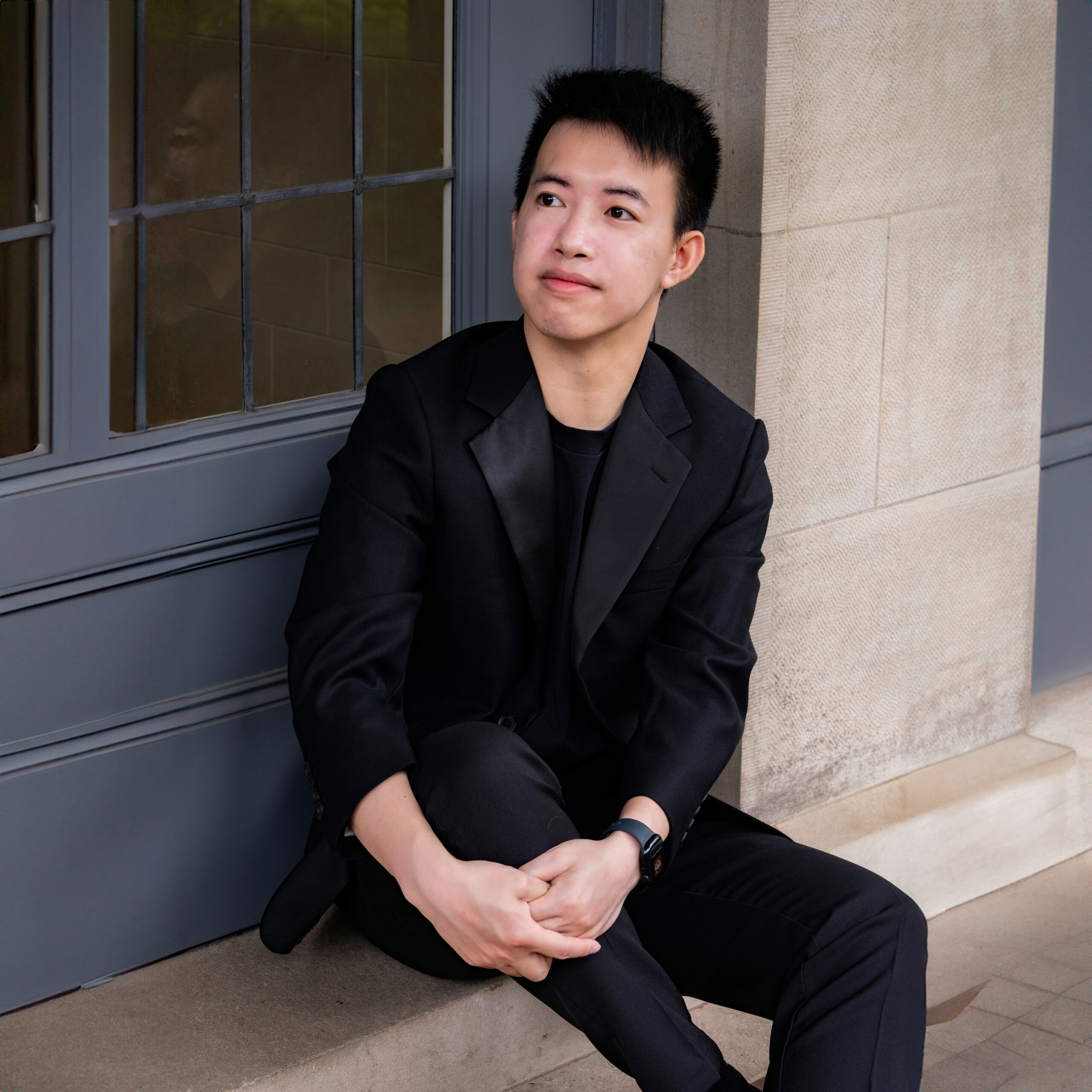
Yiqi Guo is a Chinese-born composer based in the New York Metropolitan Area whose work spans concert music, film scoring, and game audio. Inspired by Eastern aesthetics and cultural storytelling, he reimagines traditional musical elements through contemporary composition. His music has been performed across North America, Europe, and Asia, including performances and collaborations with the Mivos Quartet, four-time Grammy Award-winning ensemble Eighth Blackbird, and at Lincoln Center’s Bruno Walter Auditorium. Guo has also presented his research on Hokkien music at the Composition in Asia: International Symposium & Festival. He holds degrees from the Mannes School of Music and California State University, Long Beach, where he graduated summa cum laude.
Zechary Phouthavong is a first-year PhD student at the University of North Carolina at Chapel Hill. He holds a BA in Music (2024) and a MM in Musicology (2026) from the University of Arkansas in Fayetteville. His thesis explores how Lao Americans construct their identity through transnational music and performance, revealing a unique relationship between Lao Americans and music. As a Lao American, he plans to continue research on Lao culture and identity at UNC. Phouthavong also has interests in Asian American studies and Asian popular music, exploring how these studies intersect with his research and others.