
Asian America in 25 Songs
#15, Ái Vân and Elvis Phương, “Bài Tango Cho Em”
Historical Context | The Music | Resources
Historical Context
In the aftermath of the Vietnam War, over two million Vietnamese fled their homeland. Hundreds of thousands died at sea. Those who survived resettled in more than 20 countries. The largest number came to the United States, but many also went to France, Canada and Australia. The Vietnamese diaspora reshaped Asian communities in many countries. They diversified the communities, complicated immigrant narratives, opened new types of restaurants and developed new identities. Most in the community also experienced trauma and required social services that were often unavailable in Asian American communities. To make matters worse, resettled Vietnamese people were frequently the target of racial- and ethnically-motivated discrimination.
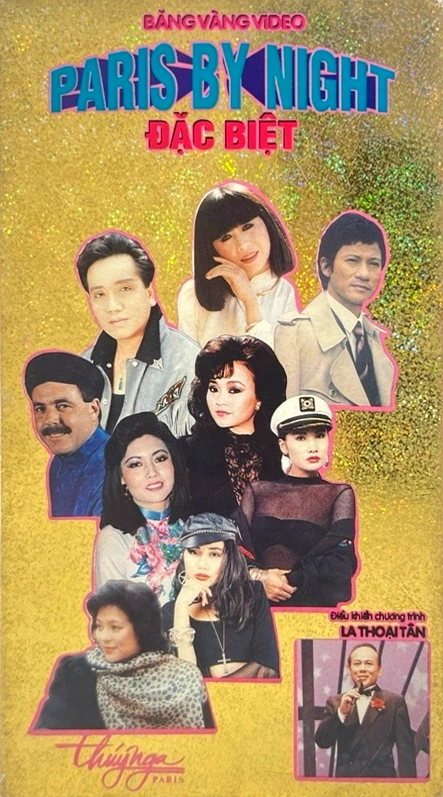
To help them survive in their new environments, many in the Vietnamese diaspora developed idealized visions of their homeland and yearned to return there some day. A key component of these visions is South Vietnamese popular culture of the 1960s and early 1970s, particularly the sentimental love songs. To serve the needs of the diaspora, community members with experience in the Vietnamese music industry started putting on concerts, and releasing cassettes, CDs and music videos that are sold at Vietnamese stores. They contained pre-1975 songs, new songs in a similar style by diasporic composers, and songs about the experience of exile. Eventually, what became most popular are direct-to-video musical variety shows released by Asia Entertainment and Thuy Nga Productions, which produces the Paris by Night series.
Over the past 15 years, the Vietnamese diasporic entertainment industry has faced increasing challenges. The most fundamental is generational shift. The number of people with direct experience of the Vietnam War and pre-1975 Vietnamese popular culture is fast dwindling, and their U.S.-born children and grandchildren often have different musical tastes. Many also do not have the Vietnamese language skills to appreciate the lyrics. Also important is the diasporic community’s changing relationship with Vietnam. While many continue to disassociate themselves from anyone who has any relationship with the Vietnamese government, others are urging a more flexible approach. This is a divide that production companies need to navigate carefully. Finally, piracy has affected these corporations’ ability to survive. In the next 15 years, there will undoubtedly be major changes to the Vietnamese diasporic entertainment industry.
The Music
“Bai Tango Cho Em” (“A Tango for You”) was written by Lam Phương (1937-2020) in the 1980s, and it has been one of the biggest hits in the Vietnamese diaspora for nearly four decades. Many professional singers have recorded the song, and many more amateurs have sung it at karaoke. It opens with the violin playing the melody of Franz Liszt’s third “Liebestraum” (“Love Dream”), which is inspired by a poem about unconditional love. Towards the end of the melody, the rhythm section establishes the tango rhythm. The singers are former lovers who have just reunited, a scenario that is not unusual in the aftermath of a war and resettlement. In this recording, the woman sings first, followed by the man. Eventually, the two sing a duet. Lyrics in the duet include “We’ll journey a thousand miles and cross a deep ocean / And hand in hand we enter our new home.” In the middle of the song, the violin once again plays the “Liebestraum” melody again, this time with more passion. Afterwards, the singers repeat the lyrics; saying it a second time makes the feelings more real.
This recording is a part of the 1991 Paris by Night Special. The singers are Ái Vân & Elvis Phương. Elvis Phương (b. 1945) was a popular singer in Vietnam in the 1960s and early 1970s. After the fall of Saigon, he moved initially to France, and then the U.S., where he had a very successful career. To the dismay of many in the diaspora, he began to perform in Vietnam again in the late 1990s, sometimes with Vietnamese artists. Meanwhile, Ái Vân (b. 1954) has an unusual background for a Thuy Nga artist. She studied at the Hanoi Conservatory and had a career in post-war Vietnam. In 1990, she was sent to East Germany to study directing. While there, she took advantage of the fall of the Berlin Wall and became a refugee. This performance was filmed shortly after her decision to go into exile.
Resources
- Nhi T. Lieu, “Performing Culture in Diaspora: Assimilation and Hybridity in Paris By Night Videos and Vietnamese American Niche Media.” In Mimi Thi Nguyen & Thuy Linh Nguyen Tu (eds.), Alien Encounters: Popular Culture in Asian America. Duke University Press, 2007, pp. 194-220.
- Jason R. Nguyen, “Sensibilities, Imaginaries, and Networks: Performing Diasporic Vietnamese Identities.” Ph.D. Dissertation: Indiana University Bloomington, 2021.
- Adelaida Reyes, Songs of the Caged, Songs of the Free: Music and the Vietnamese Refugee Experience. Temple University Press, 1999.
- Darren Tu, “How ‘Paris by Night’ Became the Spirit of Vietnamese American Life.” KQED, April 29, 2025.
- Quynh H. Vo, “A Brief History of Paris by Night, the Anchor of Vietnamese Culture Abroad.” Saigoneer, Oct. 18, 2022.
- Deborah Wong, Speak It Louder; Asian Americans Making Music. Routledge, 2004 [Chapters 4 and 5 focus on Vietnamese American music-making.]