
Historical Context
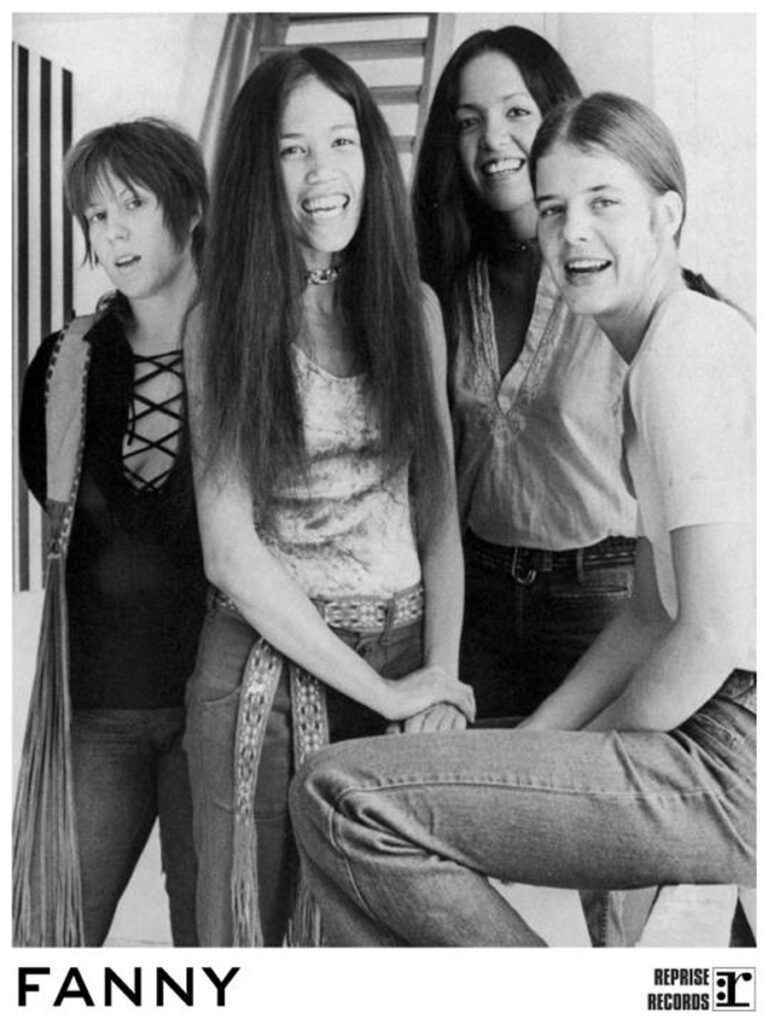
The trailblazing all-female rock band, Fanny, was founded by the Millington sisters, June and Jean. The sisters immigrated from the Philippines to Sacramento as children, a move that led them to experience racial othering and isolation for the first time. Although society deemed it improper and unladylike for women to be in a band, June and Jean were determined to make it as rock musicians. They began hosting concerts in their backyard, some of which would draw in crowds of a hundred people. Eventually, they recruited Addie Lee to play guitar, and fellow Filipina musician, Brie Brandt, to play drums. The four opened as The Svelts and had success gigging at local bars and venues. The band went through several iterations as members came and went, but at one of their final gigs, they were scouted and signed to Warner Bros. Records. The band decided to rebrand as Fanny, and they named their shared house Fanny Hill. At one point, the band consisted of The Millington sisters on bass and guitar, Nickey Barclay on keyboard, and both Brie Brandt and Alice de Buhr on drums. Their producer, Richard Perry, made the call to cut Brie so that the group would better resemble famous four-piece bands like The Beatles.
Fanny experienced many successes. They had an extremely successful tour through England opening for bands like Humble Pie and Slade, and released an album a year from 1970 to 1974. They also had many powerful admirers. In a 1999 interview with The Rolling Stone, David Bowie said that Fanny was “one of the finest fucking rock bands of their time, in about 1973. They were extraordinary: They wrote everything, they played like motherfuckers, they were just colossal and wonderful…They’re as important as anybody else who’s ever been, ever.”
Despite their skills and dedication, Fanny couldn’t quite overcome the music industry’s gender barrier. From the beginning of their Warner Bros. contract, the band members felt the pressure to constantly put out music and perfect solos. At the same time, music outlets and even their label’s own promotional team saw them as nothing more than a gimmick. They coerced the band to wear skimpier, sexier outfits to up their sex appeal. It was clear that the music industry just couldn’t see past their sex.
June eventually left the group and moved to upstate New York where she met her long-term partner, Ann Hackler. She began a solo career, refining her songwriting and eventually meeting and gigging with several bands. In time, June became a leading figure of the women’s music movement, a separatist, feminist, queer music scene by and for women.
Meanwhile, Fanny continued in the absence of June and Alice, who were replaced by Patti Quatro and former member Brie Brandt. The group released a fifth and final album, Rock and Roll Survivors (1974), as well as Jean’s hit single, “Butter Boy” (1974), a song about her relationship with David Bowie. The song reached number 19 on Billboard’s Hot 100 before it was banned in Boston and various stations for being too sexually explicit. Unfortunately, this success could not keep the band together. As members got pulled in different directions, they eventually disbanded.
While Fanny seemed to stay just out of reach of stardom for their entire career, they paved the way for all-female rock groups to come, including The Runaways, The Go-Go’s, and the Riot Grrl movement. In 2023, Fanny: The Right to Rock, a feature-length documentary of Fanny’s story, was released on PBS. The documentary sheds light on the obstacles that the musicians faced from sexism to homophobia. The documentary also features June Millington’s Institute for the Musical Arts (IMA), a non-profit that supports and encourages women and girls pursuing music and music-related fields.
The Music
Although some all-women rock bands, such as Goldie and the Gingerbreads, came earlier, Fanny was the first group to be signed to a major label and to release a full-length album. They had a strong classic rock sound, taking influences from blues, Motown, funk, soul and more. They were praised for writing all of their own music and for their incredible showmanship and on-point musicianship. Fanny was so widely recognized for their stellar playing within the music industry that they were even hired as a session band for Barbra Streisand.
In 2018, Fanny’s live recording, Live on Beat-Club ‘71–’72, was posted on YouTube. Six years later, it was remastered and released on CD and vinyl. “Charity Ball,” originally released as the title track of Fanny’s second studio album, also opens Live on Beat-Club ‘71–’72. It expresses the excitement of gearing up to dance the night away at the local charity ball. It reached the top-40 charts and became one of Fanny’s most iconic and beloved songs. Unlike the studio sessions, no recording company interfered during the Live at Beat-Club appearance. For this reason, fans see these videos as a testament to the power of Fanny’s true unfettered and unshackled sound.
Following renewed interest in Fanny after the release of Live on Beat Club ’71-’72, three original members, June, Jean, and Brie came back together to produce Fanny Walked the Earth (2018). The group’s latest release was in September 2025: Rock and Roll Survivors: Live Opera 1974. Patti Quatro first brought the idea to the group, which developed into a 7-minute song before expanding into a fully-fledged 51-minute rock opera. The narrative is winding and honest, addressing pertinent social issues and topics of “modern confusion” like gender, sexuality, drugs, and more. It begins with an apologia that lays out the journey before immediately diving into songs filled with dramatic irony meant to shine a light on the ways society turns its back on those living on the margins.
Resources
- You’ve Got A Home: June Millington’s Lifelong Journey in Rock– NPR’s article on June Millington’s Life and Rock Career
- How It Began | Fanny Rocks
- Fanny’s Rock Opera– Podcast Pt 1 and 2
- Fanny: The Right to Rock– PBS documentary link
- Fanny: The Right to Rock Q&A with Patti Quatro and Brie Howard
- Jean Millington: Full Life Interview– Women of Rock Oral History Project