
Asian America in 25 Songs
#3: Kim Loo Sisters, “Gee! The Jeep Jumps!”
Historical Context | The Music | Resources
Historical Context
In many immigrant communities, there is a serious generation gap between the first generation (those who migrated as adults) and the 1.5 (those who migrated as children) and second generations (the first to be born in the adopted home). While most first-generation immigrants try to preserve many elements of their heritage culture, lots of 1.5- and second-generation immigrants want little to do with their parents’ traditions. First-generation Japanese immigrants on Hawaiian plantations expressed their experiences by creating new lyrics and setting them to melodies from their homelands (see #1 of this resource). In contrast, most of their children communicated their feelings musically through American popular genres.
Asian Americans have played important roles in the American entertainment industry since the late 19th century. Dozens of Chinese and Filipino Americans (often performing under Chinese names) performed on major vaudeville stages as singer-actors (Lee Tung Foo, Lady Tsen Mei, Chung Hwa Comedy Four), jazz musicians (David Sum, Luis Borromeo), dancers (Harry Gee Haw, Dong Fong Gue), and magicians (Long Tack Sam). In Asian Americans enclaves during the 1920s and 1930s, youths created jazz and dance bands and opened nightclubs that catered to both second-generation immigrants and the many tourists who visited Chinatowns and Japantowns. In the 1940s and 1950s, there were enough of these nightclubs to form a “Chop Suey Circuit,” which allowed top performers to make a living as artists. Of course, many of these performers were also frustrated by the discrimination that kept them from entering the mainstream entertainment instrument. Some moved to Asia and launched major careers there (see #6 of this resource).
During the Chinese Exclusion period (1882-1943), over 250,000 Chinese people migrated to the U.S. by pretending to be the sons (and occasionally daughters) of U.S. citizens. This was possible because the fire following the 1906 San Francisco earthquake destroyed countless birth and immigration records, making it impossible for the government to verify the validity of numerous claims. Louis Shear Gim was one of these immigrants. Like many other “paper sons,” he was always fearful of being deported, and wanted to get away from anyone who might know his real family tree. This led him to move to Minneapolis, which had few people of Chinese descent at the time. There, he met a recent Polish immigrant named Michelena Wojcik, fell in love, married and had six children.
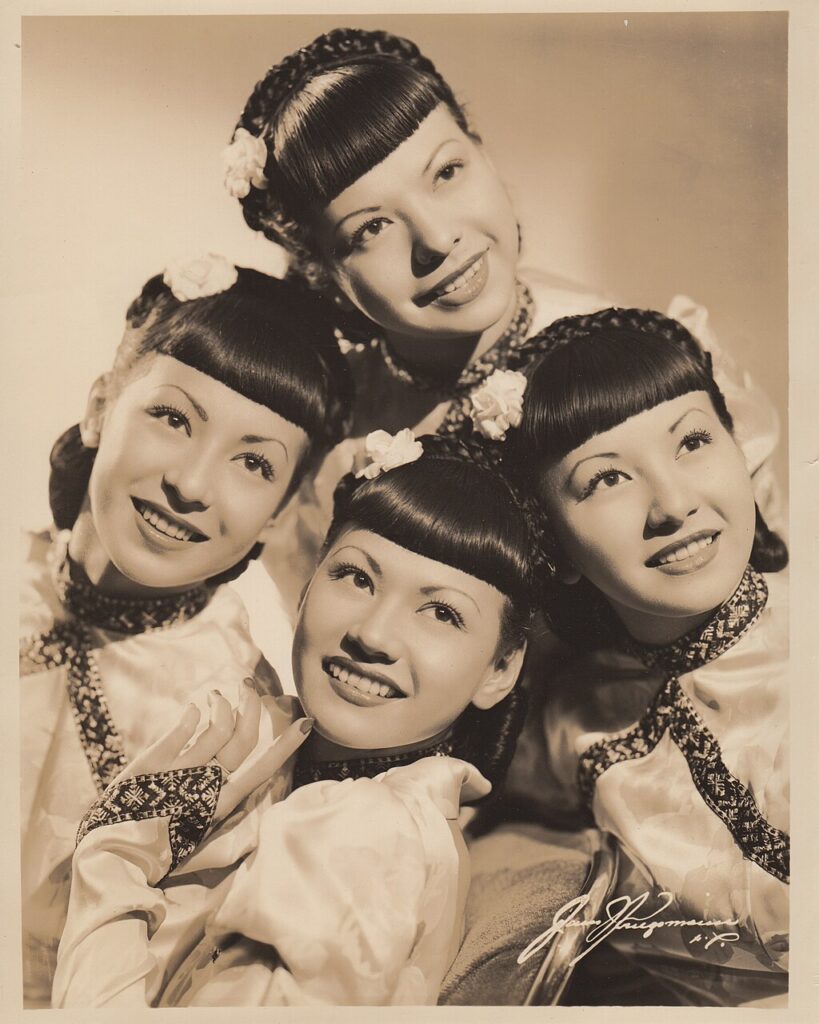
As tweens and children, the siblings began performing on the vaudeville circuit in the Midwest (and later the West) as a novelty act called Louie’s Chines Revue. As vaudeville declined in the late 1920s and early 1930s, the parents decided to have the father raise the two youngest children in Minneapolis and to create a vocal jazz quartet with the four eldest children (Alice, Maggie, Jenée and Bubbles). Often dubbed the “Chinese Andrews Sisters,” the Kim Loo Sisters performed in Chinese revues and other venues, eventually reaching Broadway as a part of George White’s Scandals of 1939, which played in New York and on tour for three years. After this, Jenée decided to leave the group to get married. The other sisters then continued as a trio. They once again performed on Broadway and helped the war effort by joining the USO. They performed shows for troops across the US and the Mediterranean theater. Their appearances were designed to help Americans change their perceptions of China and people of Chinese descent. For decades, American politicians and media have often portrayed Chinese people as enemies with beliefs that are incompatible to American culture. Now that China became a US ally in World War II, the US government had to show their troops why they needed to help China. As high-level performers of what we now call the “Great American Songbook,” the Kim Loo Sisters were safe cultural ambassadors who were able to demonstrate that falseness of both the inscrutable Chinese stereotype and the unassimilable Asian trope. The trio retired from performance after the end of WWII.
The Music
Towards the end of WWII, the Kim Loo Sisters made two soundies—music videos for coin-operated jukehouses. The second of these features a song called “Gee, the Jeep Jumps.” (The soundie itself is entitled “Jumping in a Jeep.”) Released in October 1944, it is one of at least a dozen songs about jumping jeeps. The Kim Loo Sisters’ jeep song seems to be based largely on the Andrews Sisters’ 1942 song, “Six Jerks in a Jeep,” which appeared in the Army recruitment film Private Buckaroo. The similarities between these two songs illustrate why the Kim Loo Sisters were often dubbed the “Chinese Andrews Sisters.”
“Gee, the Jeep Jumps” shows the meeting of Chinese and American soldiers, with the Chinese American Kim Loo Sisters in the middle. The setting is not made explicit in the video, but there are clues. Chongqing—the city listed on the sign in the background—was the provisional capital of China during World War II, and it was under heavy bombardment by the Japanese Air Service from 1938 to 1943. Chongqing was able to withstand this bombardment because Allied Forces, led by the U.S., was able to deliver airplane fuel across the Himalayas—initially through the Burma Road, and later using an air-route referred as “The Hump.” The Burma Road and the Hump both ended in Kunming, the capital of Yunnan Province in southern China. From Kunming, Chinese forces brought the fuel to Chongqing using some very dangerous mountain roads. Since “The Hump” was widely reported in the U.S., many viewers might have recognized the scenario presented in the video. The meeting of Chinese and American soldiers suggests that Kunming is the setting of the soundie. However, the mileage marker is way off; Kunming is over 500 miles southwest of Chongqing.
Resources
- Leslie Li. (2015). Just us girls: the Kim Loo Sisters. Four Seasons Press.
- Interview with Lily Tung Crystal about Blended, a musical about the Kim Loo Sisters.
- Eric Hung and Leslie Li, “Recovering Early Asian American Voices in American Popular Music: Two Girl Groups” (AMS-Rock Hall Lecture)