
Historical Context
Labor has always been a contentious issue in Asian American history. There is a 150-year history behind current debates about work visas and international student quotas. For much of U.S. history, there has been a labor shortage that is filled largely by immigrants. At the same time, there are people–some based on economic concerns and some fueled by racist ideologies–who argue that immigrants depress wages, bring diseases, and cause crime. These contentions led to the first immigration restrictions in U.S. history: the 1875 Page Law (which barred most Chinese women from migrating to the U.S.) and the 1882 Chinese Exclusion Act.
The substantial growth of Japanese migrants to the U.S. after the passage of the 1882 Chinese Exclusion Act led to increasing anti-Japanese sentiments in Hawai`i and the West Coast. In 1905, Anti-Asian activists created the Japanese and Korean Exclusion League (later Asiatic Exclusion League) to pressure state and federal governments to pass segregation, land ownership and restrictive immigration laws. In response, the Japanese sought to leverage its new status as a world power (in the aftermath of winning the Russo-Japanese War) to make the best deal possible with the U.S. government. The result was the “Gentleman’s Agreement of 1907.”
In this agreement, Japan agreed to stop the migration of male laborers to the U.S. In exchange, the U.S. agreed to accept Japanese people who were already in the country, to allow the wives, children and parents of existing immigrants to move to the U.S., to end the segregation of Japanese American children in California schools, and to not pass a formal Japanese exclusion act. Ultimately, the “Gentlemen’s Agreement” allowed for the establishment of sustainable Japanese American communities.
The Music
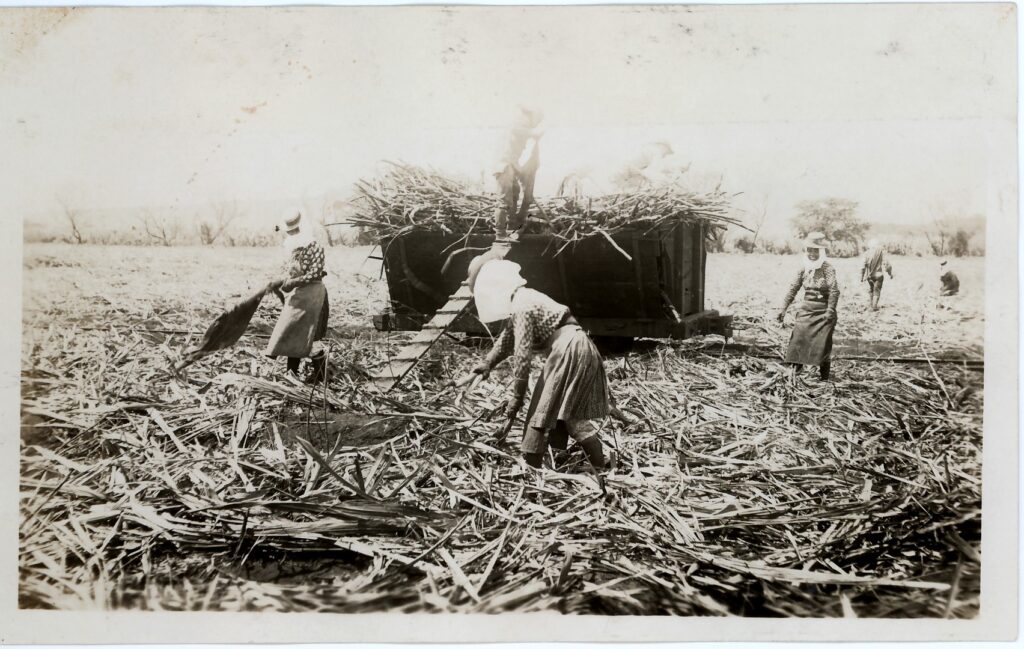
“Hole hole bushi” is a collection of songs created primarily by Japanese women who worked on sugarcane plantations in Hawai`I in the early 20th century. “Bushi” is the Japanese word for melody, and “hole hole” is the Hawaiian word for dead sugarcane leaves. In their original context, these songs were often sung by women while they removed dead leaves from sugarcane. This work led to sweeter and easier-to-process sugarcane stalks. The torn-off leaves were also used as fertilizer.
Most “hole hole bushi” melodies derive from folksongs the workers knew before they migrated to Hawai`i. Given recruitment patterns, melodies from the Hiroshima region were particularly well represented. The new lyrics the plantation workers sang dealt with all aspects of life in Hawai`i—from homesickness to the joys of a successful harvest, from oppressive working conditions to love and family life, and from anxiety about the future to experiences of discrimination. Most follow a classic Japanese four-line poetic form with a 7,7,7,5-syllable structure.
First-generation Japanese immigrants (the Issei) to Hawai`I likely created thousands and thousands of “hole hole bushi.” However, only a small percentage has survived. They owe their preservation largely to the efforts of a Honolulu music teacher named Harry Minoru Urata (1910-2009), who greatly admired the Issei. In the mid-20th century, he collected many songs and then taught them to thousands of students. He also successfully pushed scholars and documentarians to do research and create films about this repertoire. As one of Urata’s students, Allison Arakawa learned “hole hole bushi” as a teenager. When the Japanese television network NHK held its singing contest in Honolulu in 2000, Urata urged Arakawa to enter singing a medley of these songs. After initially resisting, she agreed and ultimately won the contest. This victory—along with all of Urata’s other efforts—has sparked renewed interest in this repertoire.
In this performance at the Japanese American National Museum in 2010, Arakawa sings four songs. The first expresses uncertainty about the future, and silently communicates dissatisfaction with life in Hawai`i. Staying there does not seem to be an option:
Yuko ka Meriken yō (Shall I go on to America)
Kaero ka Nihon (Or return to Japan)
Koko ga shian no (This is my dilemma)
Hawai koku (Here in Hawai’i)
— Lyrics and translation from Franklin Odo’s article on “hole hole bushi” in Densho (https://encyclopedia.densho.org/Holehole_bushi/)
The second directly voices dissatisfaction with life on the plantation:
Hawai, Hawai , to yō (Hawai`i, Hawai`i)
Yume mite kita ga (I came chasing a dream)
Nagasu namida wa (Now my tears flow)
Kibi no naka (In the canefield)
— Lyrics and translation from Franklin Odo’s article on “hole hole bushi” in Densho (https://encyclopedia.densho.org/Holehole_bushi/)
The third describes a day when everything just went wrong:
Ame wa furidasu yō (A sudden downpour)
Sentaku wa nureru (Drenches the laundry)
Sena no ko wa naku (Baby on my back sobs)
Manma kogeru (And the rice just burned)
— Lyrics and translation from Franklin Odo, Voices from the Canefields, p. 39.
Arakawa concludes with a newer song that reflects on—perhaps unexpectedly and joyfully—establishing a life and family in Hawai`i. According to Odo, it was widely sung by the Issei in the 1970s and 1980s.
Yokohama deru tok’ya (When I left Yokohama)
Namida de deta ga (I cried as we sailed away)
Ima ja ko mo aru (But now I have children)
Mago mo aru (And grandchildren, too)
— Lyrics and translation from Franklin Odo, Voices from the Canefields, p. 92.
Resources
- “Holehole Bushi” (Densho Encyclopedia)
- “Canefield Songs” Documentary
- Odo, Franklin. Voices from the Canefields: Japanese Immigrant Folk Songs from Hawaii Sugar Plantations. New York: Oxford University Press, 2012.