
Historical Context
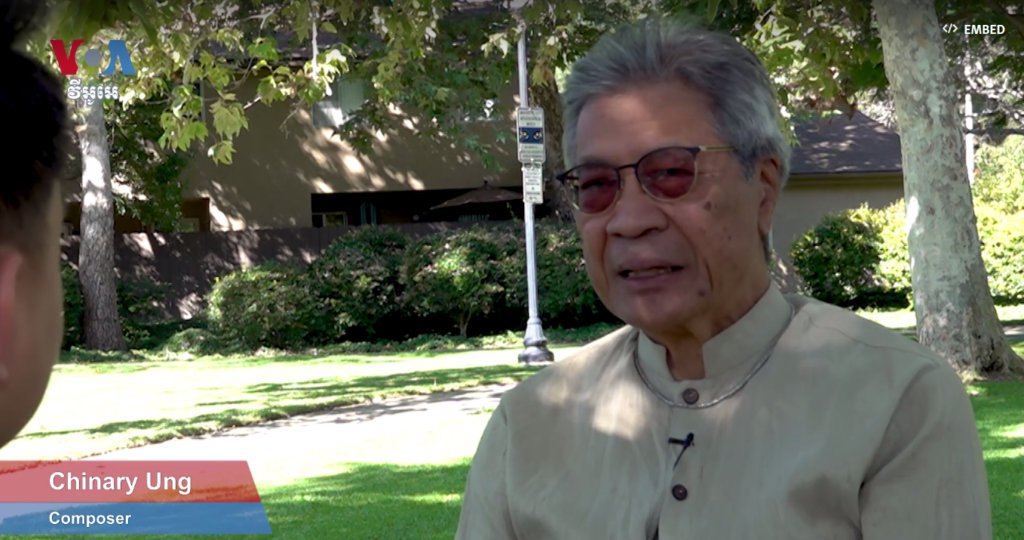
Chinary Ung (b.1942) is a world-renowned Cambodian American composer who spent decades exiled from his homeland. His compositional process and “musical fingerprint”—a term he coined to describe the style of an individual composer—are inextricably intertwined with his childhood in Cambodia and his homeland’s tumultuous political history that followed his move to the U.S.
Ung spent his early childhood living with his grandparents in the small village of Prey Lvea (ឃុំព្រៃល្វា), where he was rarely exposed to modern luxuries such as running water or electricity. Although technology was sparse, music was abundant. His father played roneat ek (រនាតឯក), a wooden xylophone-like instrument that leads various traditional Cambodian ensembles. In the village, Ung recalls a constant, rich musical landscape filled with folk musicians, people singing while selling wares, and a traveling pinpeat ensemble (ពិណពាទ្យ), a mostly wind and percussion orchestra that accompanies dance, plays and ceremonies. He showed unusual musical aptitude, making music with clay jugs, bamboo sticks, or anything else he could find that made an interesting sound. At eighteen, he was sent to L’Ecole Nationale de Musique in Phnom Penh (ភ្នំពេញ) where he studied European music repertoire and style, with a special focus on the nineteenth and early-twentieth centuries. His appetite for knowledge led Ung to plead with the Minister of Education for an international travel exemption. Once given permission, he received funding from Asia Foundation to go to New York in 1964 to study at Manhattan School of Music. He spent the next four years studying Western Classical clarinet performance, and took advantage of New York’s rich live performance scene. After hearing the East-West fusion of Chou Wen-chung’s music at a concert, Ung convinced the Chinese American composer to teach him privately.
Upon graduation in 1968, Ung prepared to return to Cambodia. His father recognized an increasingly unstable political landscape in their homeland and encouraged him to stay abroad. Through a stroke of luck, Ung was able to remain in the U.S. through assistance from the fairly new JDR 3rd Fund (John D. Rockefeller). He visited Cambodia for a month before returning to the U.S.; he would not see Cambodia again for over three decades.
Ung’s late-twenties and thirties was a period of personal and professional growth. He pursued his DMA at Columbia University and began publishing articles that considered potential interplay between Eastern and Western musical styles. Most importantly, he came to believe in the necessity of honoring one’s cultural roots in developing one’s own “musical fingerprint.” This led him to study traditional Cambodian music intensively. Political unrest made it impossible for Ung to visit Cambodia. Therefore, he asked his friends and colleagues who travelled through Southeast Asia to procure traditional Cambodian music recordings. Soon, even the shipments of music recordings stopped.
Just as Ung’s interest in his heritage deepened, his homeland came under the control of a murderous regime. The Khmer Rouge (ខ្មែរក្រហម) government (i.e., the Communist Party of Kampuchea, or, the CPK) took power for three years, eight months and twenty days, from April 1975 to January 1979, and left widespread death and devastation in its wake. Under the guise of a revolution of the peasantry, Democratic Kampuchea’s dictator Pol Pot (ប៉ុល ពត) enacted a Leninist autarchism, employing totalitarianism, egalitarianism, extreme agrarianism, and state-sanctioned and -sponsored Cambodian genocide. There was a general sense of antagonism towards cities and everything they stood for. Cambodians were expected to abandon their prior lifestyles and focus on agricultural reform. This immediately resulted in widespread famine, disease, and death. Pol Pot referred to this process as “levelling down,” wherein it was posited that the entire Cambodian society should abandon technological advancements and embrace regression if all citizens did not have access to them. National self-reliance was adopted at any cost. Folks deemed bourgeois, non-Khmer (the largest ethnic group in Cambodia), or otherwise powerful were considered enemies of the state, which included—but was not limited to—musicians, artists, multilinguists, intellectuals, racial minorities, religious leaders, prior political leaders, and current political subversives. Those who couldn’t adapt to the farming lifestyle or were regarded as too subversive were “reeducated”—tortured and often killed. By the time the Khmer Rouge were ousted, a quarter of Cambodia’s population, approximately two million people, had died.
Ung spent this time period living in confusion, left in the dark as to what was happening to his friends and family in Cambodia. He took a hiatus from composing. In 1975, Ung won a grant to commercially publish the Cambodian traditional music he’d spent years gathering prior to the war. These recordings, Cambodia: Traditional Music. 1: Instrumental and Vocal Pieces (FE 4081) and Cambodia: Traditional Music. 2: Tribe Music, Folk Music and Popular Dances (FE 4082), released in 1978 and 1979 through Folkways Records (later, Smithsonian Folkways Records), became a valuable ethnomusicological resource, keeping alive the culture of a threatened population. Ung edited the recordings and wrote liner notes to accompany each record. The end of Volume 1’s liner notes reads, “This album is dedicated to the memory of the Cambodian people who have suffered senselessly and lost their lives in war.” These were the experiences leading up to Ung’s seminal composition, Khse Buon.
The Music
Ung decided to write music again in 1980, and his first work was “Khse Buon” (“four strings”) for solo cello. The title alludes to the kse diev (ខ្សែដៀវ), a single-stringed Cambodian instrument used in traditional music. The title demonstrates Ung’s desire to decenter the cello’s Western heritage and to make it more global. One is reminded of Ung’s young adulthood, when his exposure to Western classical instruments and composers came long after his exposure to and interest in other musical traditions. He therefore approached Western classical music not as the “standard” musical language, but as just another tradition. This allowed him to view the cello with some sense of cultural neutrality. In “Khse Buon,” the cello is, on the one hand, a four-stringed instrument; nothing more, nothing less. On the other hand, the reference to kse diev evokes the ancient and a sense of intimacy. It is often considered oldest Khmer instrument and the “instrument of the heart,” since the instrument’s resonating gourd is held close to the chest. Ung is using the four-stringed instruments to do something very personal: to understand what his Cambodian roots mean in the aftermath of the Khmer Rouge.
With the cello removed from its traditional Western context before a single note is played, techniques not typically used on a cello sound less experimental, as if the cello could easily be a Cambodian folk instrument. A year before writing Khse Buon, Ung states in the liner notes to Cambodia: Traditional Music. II, “. . .in most folk and tribal music of Cambodia, two essential elements form a distinct foundation — the sound of drones and the effect of rhythmic patterns executed with a limited number of notes.” Ung employs this technique early in Khse Buon; the cellist plays a drone on one string while a modal melody is played on another. As the music proceeds, additional sounds expected from traditional Cambodian folk music are offered: plucked strings vibrating on wavering tones (imbuing meaning onto tonal nuance over precision); harmonic overtone manipulation; slide pizzicato; and frequent glissandi between notes. The rhythm also fluctuates—the majority of the piece unmetered—and any underlying sense of metric consistency is undercut by lengthy fermatas strewn throughout the piece. All these techniques help to evoke the Buddhist concept of timelessness as spiritually rich. Relatedly, Ung evades Western norms with the piece’s form. The score includes the option for the performer to skip or reorganize sections of the music as they please. In other words, Khse Buon follows a non-teleological design uncharacteristic of most Western music styles (with some exceptions, e.g., Stockhausen’s Klavierstück XI and John Cage’s Music of Changes). This, too, has roots in Buddhist teachings on mindfulness. With both meter and form in a state of purposeful fluidity, musical moments become the focus.
At first glance, Ung’s reimagining of the cello appears similar to the innovative way some contemporary Western composers employed extended performance techniques. Indeed, Ung studied and interacted with the experimental composers of his day. But Ung’s motivations were entirely different from his counterparts. Where experimental Western composers sought to stretch what an instrument could do within the classical space—which can come across as complex, highbrow, and an intellectual exercise—Ung wrote for an Western instrument lifted out of its Western classical context. The Eastern-sounding techniques seem natural to the instrument, not experimental. The composing is warm and familiar, not foreign or overly intellectual. And where some of his classically trained contemporaries were stretching the formal, melodic, and rhythmic constraints of what classical music could be, coming from a desire to be innovative, Ung achieved some of the same effects by drawing from his traditional Cambodian roots. Both methods create a new sound and experience, but with vastly different motivations and cultural contexts.
Resources
- Chinary Ung’s website
- Unesco Phnom Penh, “Sok Duch – Kse Diev Master” (4-minute documentary about Kse Diev and 88-year-old master musician Sok Duch)
- Chinary Ung (ed.), Cambodia: Traditional Music, Vol. 1: Instrumental and Vocal Pieces. Smithsonian Folkways, 1975.
- Chinary Ung (ed.), Cambodia: Traditional Music, Vol. 2: Tribe Music, Folk Music and Popular Dances. Smithsonian Folkways, 1979.
- Mark Berger, “Khse Buon.” (This is a personal reflection of a violist who has performed a transcription of Khse Buon.)
- Bosba Panh, “Articulating Khmerness: Khmer Agency in Western Art Music.” Ph.D. Dissertation: University of Cambridge, 2021.
- Mark A. Rhodes, II. “Musical Work: Traditional Cambodian Music and State-Building under the Khmer Rouge.” Asia Pacific Viewpoint, 62(1), 2021, pp. 27-39.