
Historical Context
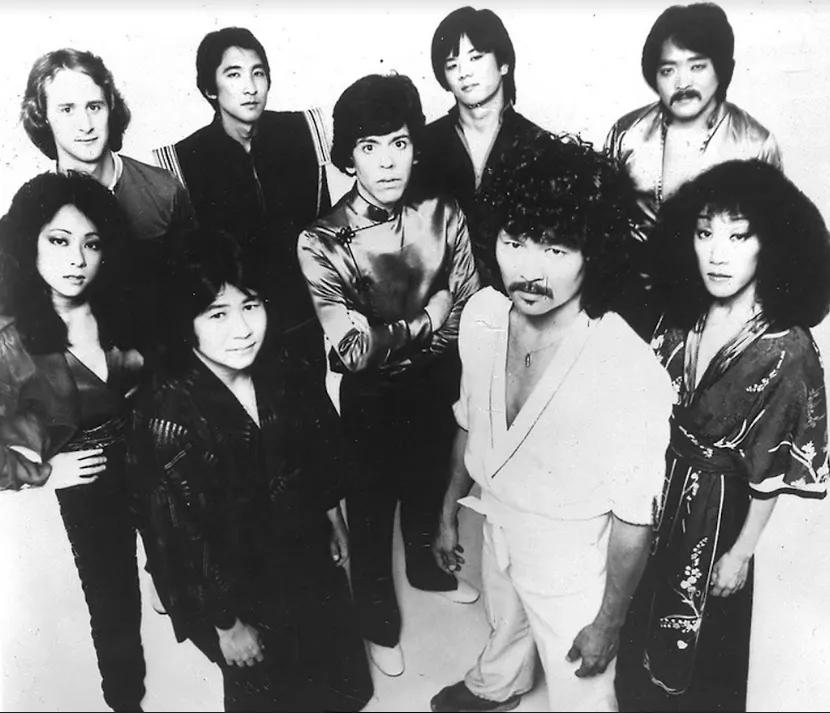
The Asian American movement (discussed in #8 of this resource) inspired many musicians to write music that uniquely communicated Asian American experiences. Chris Iijima, Nobuko Miyamoto and Charlie Chin used a folk revival-inspired style to proclaim a new Asian American identity and to build solidarity with other people of color. Meanwhile, the band Hiroshima expressed their bicultural lives by putting Asian instruments and musical techniques into a jazz-pop environment.
Hiroshima’s founder, Dan Kuramoto (b. 1945), became one of the first university instructors of Asian American Studies when he began teaching at Cal State Long Beach in 1969. At the time, the concept of a “pan–Asian American” agenda was brand new, and something Kuramoto believed would help his community. Playing in a band was something he did for fun, and he formed an experimental art band in 1974 that would soon become Hiroshima. The band did not become serious until Kuramoto met his future wife, June Okida (b.1948), a classical koto (箏) player. June’s love of the koto, widely considered Japan’s national instrument, was complicated. She began playing koto after her grandmother died and nobody else wanted the instrument. In high school, she experienced bigotry when people learned she played koto, which led her to keep her playing hidden from classmates until college. It was June’s idea to add the koto to Kuramoto’s band. She believed that, if other people “heard it [koto] in a contemporary setting, maybe they could hear the beauty of the sound of the instrument.” So, she asked Kuramoto if she could bring her koto to a band rehearsal and jam. He agreed, and the characteristic sound of Hiroshima was born. Shortly after, taiko player Johnny Mori (b.1949) also joined the band.
Hiroshima has taken inspiration from many musical genres, but, at its core, it is a jazz-fusion band. June has spoken at length about the influence Black musical genres have had on the band. She says that a lot of jazz is “searching for your roots,” which is something she admitted to having difficulty doing as a 1.5-generation immigrant (someone who moved as a child). June stated, “They [the Black community] knew what it meant to search for their identity, and to express that in some artform, especially with beat.”
The Music
After Hiroshima got their first record deal, they went on a promotional tour and their first stop was Howard University in Washington DC. Their audience’s excitement exceeded what the band members anticipated. This might be attributable to the fact that, prior to touring, the Los Angeles jazz radio station KKGO (now KKGO-FM) repeatedly aired “Kokoro” (on Hiroshima, 1979, Arista). By the time the band got on the road, they had already gained a cult following, particularly in the African American community. From the beginning, the Black community has been Hiroshima’s biggest fanbase, and the band returned regularly to Howard University.
“Kokoro” is a slow, groovy, smooth jazz track with R&B influences and a mixture of Western and Japanese instruments. The first sound on the track is a temple bell of some sort, perhaps a small bonsho (梵鐘), immediately communicating to the listener that this is not your typical smooth jazz. After this, the guitar, bass guitar, warm synthesizers, and cymbal-heavy percussion build a conventional smooth jazz groove. Over this, the shakuhachi and koto carry the winding melody in delicate unison. A funky, sexy slap bass interlude provides some contrast before we hear the first section’s melody again. A new, darker melody is then introduced, which is expanded and improvised upon through the end of the track. As this piece proceeds, the koto becomes more and more expressive and virtuosic, playing short solos with increasingly dazzling upward and downward glissandos and tremolos. Throughout, a descending hirajōshi scale (a common Japanese five-note scale with two semitones) played by the koto and shakuhachi divides each section, and reinforces the Japanese influence.
Resources
- Ellen Endo. “Hiroshima the Band: This is Not Goodbye.” Rafu Shimpo. January 4, 2022.
- Duane Kubo (director). Cruisin’ J-Town. 1975. (Documentary about Hiroshima)
- NAMM Oral History Program. Interview with Kimo Cornwell. May 19, 2024.
- NAMM Oral History Program. Interview with June Kuramoto. May 19, 2024.
- Jeong Park. “Hiroshima, a Band that Helped Define Asian American Identity, Will Take a Hiatus.” LA Times. October 29, 2022.