
Asian America in 25 Songs
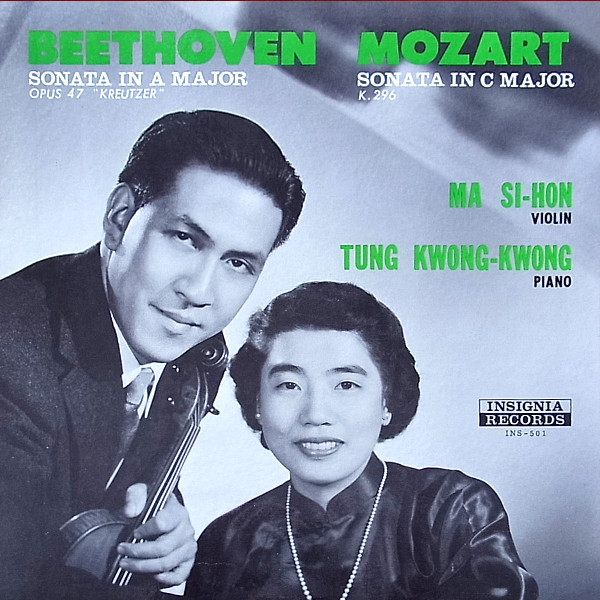
#4: Ma Si-Hon and Tung Kwong-Kwong play Beethoven
Historical Context | The Music | Resources
Historical Context
In the 19th century, European colonialism and American gunboat diplomacy forced East Asian governments to adopt radical Westernization programs, which included the development of Western music education curricula and the founding of institutions for Western classical music. To accomplish these goals, these governments welcomed foreign musicians and sent promising students to train in Europe and North America. Prominent East Asian musicians who attended American universities in the late 19th and early 20th centuries include Huang Zi (Oberlin and Yale), Yuen Ren Chao (Cornell and Harvard), Nobu Kōda (New England Conservatory), Isawa Shūji (Bridgewater State University and Harvard) and Ahn Eak-tai (University of Cincinnati, Curtis Institute of Music). As the new curricula and institutions took root, knowledge of and the ability to perform Mozart, Beethoven and Brahms became markers of sophistication and urbanity. The genre was simultaneously a symbol of China’s colonized status and a way for Chinese people to claim agency and an equal place in the modern world.
The repeal of Chinese exclusion in 1943 (but not people with other Asian nationalities) and the end of World War II two years later allowed a small number of Chinese musicians to move to the United States. The couple featured on this recording were both born into elite families that were highly invested in Western classical music. Tung Kwong-Kwong (1927-2013) was the daughter of Wong Zoen-Yien, a New England Conservatory-trained concert pianist and a renowned music pedagogue. Tung studied first with her mother, and then with Mario Paci, the Italian conductor-pianist who was instrumental in building up the Western classical music infrastructure in Shanghai. In 1947, she moved to the United States to study with Artur Schnabel. Tung became one of Arthur Fiedler’s favorite soloists with the Boston Pops. Ma Si-Hon (1925-2009) was the son of Ma Yuhang, a Chinese revolutionist and the former Finance Minister of the Guangdong Province. Several of his children established notable careers in Western classical music. The most famous sibling is Ma Sicong (1912-87), who composed several works that are still regularly performed and is often dubbed the “King of Violinists” in China. Ma Si-Hon came to the United States in 1948 to study at the New England Conservatory. Ma was the very first winner of the Heifetz Award, pioneering his generation of classical musicians from the Sinophone world. After receiving his Master’s degree and Artist Diploma, he played in the Cleveland Orchestra for five seasons. After this, Ma and Tung focused on their solo and chamber music careers. They also co-founded programs for talented young musicians and New York City-based Si-Yo Music Society, for which they curated its chamber music series for three decades.
The Music
From the late 1950s to the early 2000s, Ma and Tung gave numerous duo concerts in Western Europe, North America and East Asia. Critics often praised their fresh interpretations, the beauty of Ma Si-hon’s tone, and the couple’s unanimity of playing.
Beethoven’s Kreutzer Sonata is one of the most important pieces in the violin-piano repertoire. Composed in 1803, it is known for its technical virtuosity and emotional scope. It begins with a dark and brooding movement that seems to portray an anguished character. This movement inspired Leo Tolstoy’s novella Kreutzer Sonata, which is about a husband who murders his wife out of jealousy. This novella in turn inspired Leos Janacek’s string quartet with the same title.
The second movement is based on a seemingly tranquil theme, but you are never far from something off-kilter: weird extended trills (rapid alternation between two notes), strange harmonies, and unexpected rhythms. Many of these evoke smiles, but some appear to be darker. The final movement is a tarantella—a southern Italian dance form inspired by the myth that a tarantula wolf spider’s bite would lead to hysterical behavior. Although there is a sense of restlessness in much of the movement, it ends jubilantly.
Ma and Tung made this recording in 1963, during the early part of their touring careers, when many critics penned reviews that are full of Asian stereotypes. When signing with Columbia Artists Management that same year, agents suggested that the couple perform “showy” and perhaps popular tunes—instead of Western classical repertoire— to underscore their “cute Asian couple” image, but Ma and Tung insisted that they not play anything other than classical sonatas during the first year of their contract. This LP, which also contains Mozart’s Violin Sonata in C Major, K. 296, helped them establish themselves as major artists. By recording one of the most celebrated and technically demanding works in the violin-piano repertoire, they claimed that people of Asian descent belonged on the most famous Western classical stages. The Kreutzer Sonata remained one of the couple’s calling cards for the remainder of their careers.
Acknowledgements
MAARC would like to thank Bess Xintong Liu, Assistant Professor of Musicology at Indiana University, for her assistance with this guide. Certain details about the Ma and Tung families are from Liu’s interviews with Ms. Wang Zhen-Mei, Ma Si-Hon’s niece. For more on Liu’s research, please read her dissertation, which is linked below.
Resources
- Sheila Melvin and Jindong Cai. (2004). Rhapsody in Red: How Western Classical Music Became Chinese. Algora Publishing.
- Grace Wang. (2015). Soundtracks of Asian America: Navigating Race through Musical Performance. Duke University Press.
- Pioneering Music Duo Blazed Paths in the West for Musicians from the Orient (Taiwan Today, Sept. 1, 1983)
- Xintong Liu. (2023). Resonant China: Transnational Music-making and the Construction of the Public, 1934-1958. D. Dissertation, University of Pennsylvania.