
Historical Context
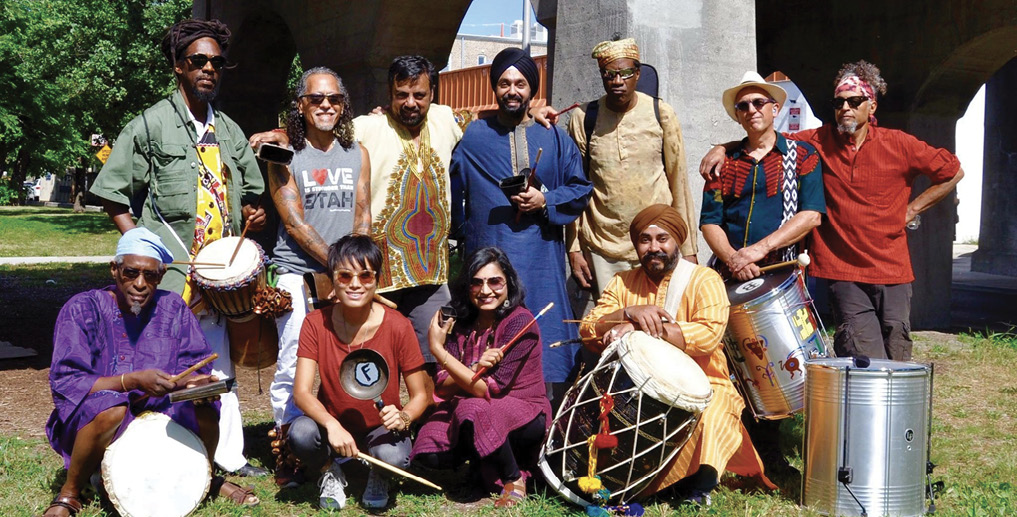
Chicago, the “city of neighborhoods,” seems a likely place for the formation of a group like Funkadesi, an Afro-Asian fusion music ensemble with musicians of diverse backgrounds. Jazz woodwind player, Lloyd Brodnax King, performs and composes for a variety of Chicago-based projects outside of Funkadesi, while vocalist, Pavithra Anand, sings in a variety of Indian languages and styles. While Funkadesi represents a point of intercultural contact and fusion, the same is not necessarily found in the wider Chicagoland area. Despite the numerous ethnic neighborhoods around Chicago, there are few places that actually promote contact between these communities. Funkadesi’s performances bring both their artists and Black and Brown communities into the same space to share the dance floor.
Funkadesi gives us insight into what cross-cultural exchange and collaboration can produce. Rahul Sharma founded Funkadesi in 1996. With his background as a bassist playing funk and reggae, combined with his tabla and sitar training, Sharma was deeply invested in the ways he could merge his seemingly disparate musical interests. As an undergrad, he was experimenting with ways to introduce Indian elements into his slap bass licks. Then, as a graduate student studying intercultural psychology in Chicago, he formed a band that could fulfill his vision of making intercultural music that brings communities together. In his eagerness to begin playing, he booked the band a gig at the Heartland Cafe before all the musicians had even signed on. From that December show in 1996 onwards, Funkadesi has been bringing audiences to their feet with their motto, “one family, many children… insisting we all belong.”
Outside of Funkadesi’s performances, band members are deeply committed to the welfare of their communities. Members bring their experiences as social advocates, healers, and educators together to deliver hybrid workshops aimed at showcasing diversity and fighting racism. At one workshop in Detroit, bandmembers split participants into different rooms to learn Latin clave, West African lambah, Punjabi bhangra, and Brazilian samba, giving participants an opportunity to share in the intercultural and musical discourse of the band. They see every performance as an opportunity to educate and as an evolving process where they focus on overcoming and celebrating their cultural differences.
The Music
Rahul Sharma describes Funkadesi as a “21st-century American garage band.” Funkadesi combines bollywood, reggae, bhangra, funk, and Caribbean genres into cohesive upbeat dance music. Sharma was originally inspired by the Punjabi hip-hop scene in England that combined bhangra with house music and hip-hop. Artists such as Johnny Zee and Bally Sagoo gave Sharma the idea to combine his backgrounds in funk and Indian classical music. As a multinstrumentalist with cross-genre training, Sharma has found that he can “play the sitar in a very Western way and the [bass] guitar in a very Indian way.” Among members, Sharma isn’t the only one with multi-tradition performance training. Guitarist and vocalist Gerald “Toto” Alfred combines elements of jazz, reggae, and Haitian kompa in his playing. Percussionist Rich Conti has studied jazz, Javanese gamelan, and Brazilian samba. Vocalist Pavithra sings in both bollywood and bhangra styles in a variety of languages, including Hindi, Tamil, Telugu, Kannada and Malayalam. Together, they create music that combines elements of longstanding traditions in innovative ways. They go beyond juxtaposing different traditions without erasing difference, and they are always aware of issues of power and privilege in creating fusion.
Through the many iterations of the band, Sharma credits the group’s ability to collaborate so effectively on each musician’s capacity to “fit in” to the groove. Ethnomusicologist T. Carlis Roberts describes Funkadesi’s music as a form of “sono-racial articulation,” meaning that distinct and disparate genres find new and unprecedented ways to interlock with each other to create cohesive melodies. This is not an intuitive process, but a highly practiced skill of listening and compromising that is constantly renegotiated both in practice and on stage. Funkadesi’s artistic practice involves negotiations not just of music, but also of race and gender hierarchies. By borrowing and sharing techniques across traditions, members of Funkadesi must confront their musical and cultural differences to find a common ground from which to connect and to play in new ways while honoring their unique musicianship and experiences.
To date, Funkadesi has released three studio albums. Their first album, Uncut Roots, was released in 2000, followed by It’s About Time in 2003. Funkadesi’s hit song, “Makhana,” was first released on their third and most recent studio album, Yo Baba, in 2008. “Makhana” is the Hindi word for fox nuts or lotus seeds. A puffed, light, and airy ingredient served in both sweet and savory dishes across India and Asia, it is most commonly eaten freshly roasted or fried in ghee and spices. Funkadesi’s “Makhana” celebrates the beloved snack as a catchy, danceable, call-and-response tune with the audience. While fans await news of a fourth studio album, they can be sure that Funkadesi will continue their joyous music-making as they celebrate their 30th anniversary as an ensemble in 2026.
Resources
- Funkadesi website
- Articulating Interracial Space: Funkadesi’s “One Family” – Chapter 3 from T. Carlis Robert’s Resounding Afro Asia: Interracial Music and the Politics of Collaboration
- Funkadesi: a blend of Indian, reggae, funk and Afro-Caribbean sounds– a For the Daily News article
- Rahul Sharma of Funkadesi on Wine & Music Wednesday– interview with Rahul Sharma on the Cawffee Tawk podcast