
Asian America in 25 Songs
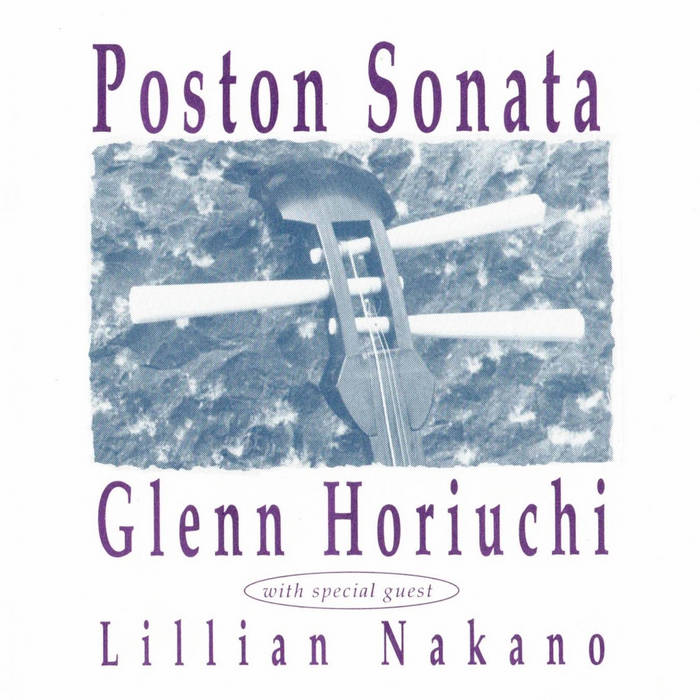
#7: Glenn Horiuchi, “Poston Sonata”
Historical Context | The Music | Resources
Historical Context
Two months after the bombing of Pearl Harbor, President Franklin D. Roosevelt signed Executive Order 9066, which authorized the Secretary of War and any military commander he delegated “to prescribe military areas…from which any or all persons may be excluded.” This resulted in the forced removal of 110,000 people of Japanese descent—two-thirds of whom were U.S. citizens—from their homes on the U.S. West Coast to ten inland incarceration camps. Publicly, the order was justified as “military necessity.” However, various federal agencies that studied Japanese American communities for years before Pearl Harbor had concluded that they posed little threat to the U.S. in a potential war with Japan.
Japanese Americans who were incarcerated were traumatized in many ways. There was the psychological trauma of being incarcerated simply for one’s ethnicity without due process. Then, there was the trauma of living in inhospitable environments under constant surveillance by often demeaning guards. For most, incarceration also meant financial trauma. Many had to sell their properties at huge losses. Although some found faithful friends to watch the lands the incarcerees had to leave behind, many caretakers simply took over properties.
After WWII, most traumatized Japanese Americans focused on building new lives, and stayed quiet about their experiences at the camps. This began to change in the late 1960s and especially the 1970s, when more and more people spoke out about the injustice of the incarceration. These activists coalesced into the Redress Movement, which fought to obtain the restitution of civil rights, an official apology from the federal government, and monetary compensation for survivors. The Movement culminated with the passage of the Civil Liberties Act of 1988, which provided an official apology, a $20,000 reparation for each surviving detainee, and a ten-year fund for educational programs on the Japanese American incarceration during WWII. The goal of this fund was to prevent future injustices.
The Redress Movement was largely about changing the dominant narrative. It aimed to show why the “military necessity” rationale was factually inaccurate, and to replace it with a narrative that demonstrated both the anti-Japanese racism that drove the policy and the resilience of Japanese Americans. Given this project, it is no surprise that Asian American artists played really significant roles in the Movement. They not only attended protests and hearings, but also created paintings, plays, novels and music that showed how Japanese Americans actually lived the incarceration and what long-term effects these experiences have generated.
The Music
In the late 1970s and early 1980s, a group of young Asian American musicians, based mostly in the San Francisco area, looked to create a politically progressive music that can express the lives, struggles and resilience of Asian Americans. They found inspiration in free jazz, particularly the creative music movement, as well as aspects of Asian musical traditions. To give themselves spaces where they could develop their vision, this collective—which included Jon Jang, Francis Wong, Anthony Brown, Mark Izu, Jason Kao Hwang and Fred Ho—founded the Asian American Jazz Festival and, later, Asian Improv aRts.
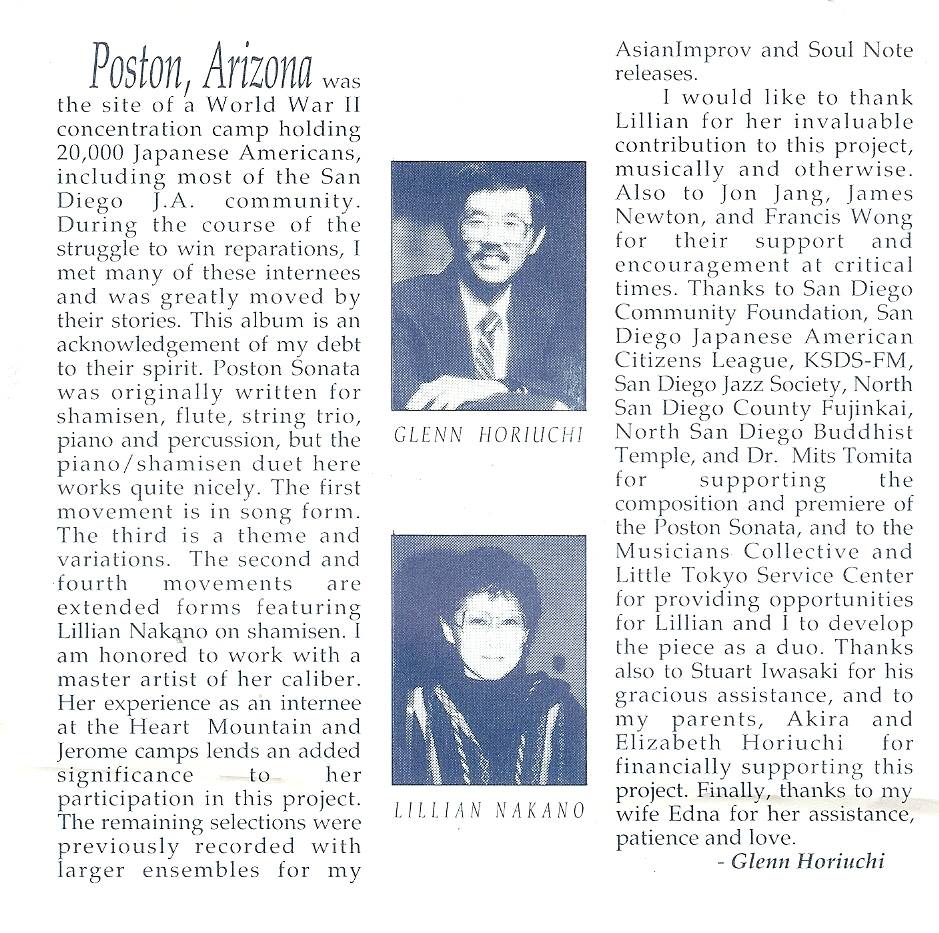
Glenn Horiuchi (1955-2000) was a fourth-generation Japanese American and a central figure in this collective. He was a polymath who played piano and shamisen, worked as an auto mechanic, and attended graduate school in mathematics. Like much of the San Diego Japanese American community, many of his family members were incarcerated in Poston, Arizona during World War II. His aunt Lillian Nakano (1928-2015) was a second-generation Japanese American from Honolulu. She was incarcerated at the Jerome (Arkansas) and Heart Mountain (Wyoming) camps. Nakano was a leader of the Redress Movement, which Horiuchi was also very active in. She began learning shamisen at the age of 8. Although camps had very active traditional music scenes (see resources), she did not continue learning the instrument during incarceration. She resumed her training after WWII. Although she focused on classical shamisen repertoire, Nakano performed with Horiuchi on several occasions in the 1980s and 1990s. Most of these were associated with the Redress Movement.
Dedicated to the spirit of the 20,000 former incarcerees of that camp, “Poston Sonata” contains two movements for piano solo (the 1st and 3rd) and two movements for piano and shamisen (the 2nd and 4th). [There is also a version for larger ensemble.] Although all four movements evoke Japanese musical traditions, the duets are the movements that—for Horiuchi—really express the feeling of being Japanese American. In an interview with the Los Angeles Times, Horiuchi said, “The thing for me as a Japanese-American—it’s not like I grew up in Japan. I haven’t even been there. But growing up, you hear different things. When I was a kid, my grandfather used to sing traditional Japanese songs, but at the same time, one of my aunts used to play Stravinsky and Beethoven, and on the radio I was hearing Motown and rock ‘n’ roll. Those are the kinds of influences I’ve gone through. I want to try to articulate that experience, at least for myself, in some coherent whole” (Dirk Sutro, “Pain of WWII Internment Permeates Music”). This is more clearly demonstrated in the fourth movement, “Celebration.” As Susan Asai’s analysis shows, the movement includes a melody built from idiomatic phrases on the nagauta shamisen over a jazz harmonic/rhythmic framework and taiko rhythmic patterns (Susan Asai, “Transformations of Tradition: Three Generations of Japanese American Music Making”).
Resources
- George Yoshida. Reminiscing in Swingtime: Japanese Americans in American Popular Music, 1925–1960. San Francisco: National Japanese American Historical Society, 1997.
- Shirley Kazuyo Muramoto-Wong (Dir.). Hidden Legacy: Japanese Traditional Performing Arts in the WWII Internment Camps. 2014.
- Deborah Wong. Speak It Louder: Asian Americans Making Music. New York: Routledge, 2004.
- Eric Hung. “Sounds of Asian American Trauma and Cultural Trauma: Jazz Reflections on the Japanese Internment. MUSICultures, 39(2), 2012, 1–29.