
Historical Context
Although the vast majority of Asian Americans before 1970 were of Chinese, Japanese and Filipino descent, people of South Asian descent have been in North America since the colonial period. The earliest migrants came as servants to members of the British East India Company. Around the turn of the 20th century, many Punjabi Sikhs came to the Western U.S. to build railroads, labor in lumber mills and work on farms. At the same time, Bengali peddlers were selling textiles and other handicraft up and down the east coast. Many of them eventually settled in New Orleans and Harlem, and married into Black and Puerto Rican families. By 1920, there were over 6,000 people of South Asian descent in the U.S. Unfortunately, we have few recordings of music-making by these early immigrants from the Indian Subcontinent.
Judi Singh (1945-2021) was the daughter of one of the first South Asians and one of the first African Canadians in Alberta. Her father, Sohan Singh, immigrated from Punjab to Canada in 1907, and her mother, Effie Jones, was the daughter of a former enslaved man from Mississippi who sought to escape racial terror by resettling in Amber Valley, Canada’s largest Black farming community, located 100 miles north of Edmonton. Although the province did not have official miscegenation laws, Judi’s parents were one of the many mixed couples brought together by mutual discrimination. They both attended Edmonton’s only Black church in the early 20th century, Shiloh Baptist Church, which also welcomed the small Sikh community. Judi grew up in a musical household. She discovered her love of singing by the age of 5, and listened to both African American music (gospel, blues, jazz) and Indian classical music in her youth.
In 1957, a jazz club named Yardbird Suite opened in Edmonton, and Singh’s cousin, Ken Chaney, was one of the founders. The venue provided a space for local musicians to jam, and for up-and-coming musicians to cultivate their craft. In time, it developed a reputation as a jazz destination, and hosted such major touring artists as Art Blakey, Wynton Marsalis, Stan Getz, Chet Baker and Dexter Gordon.
The Music
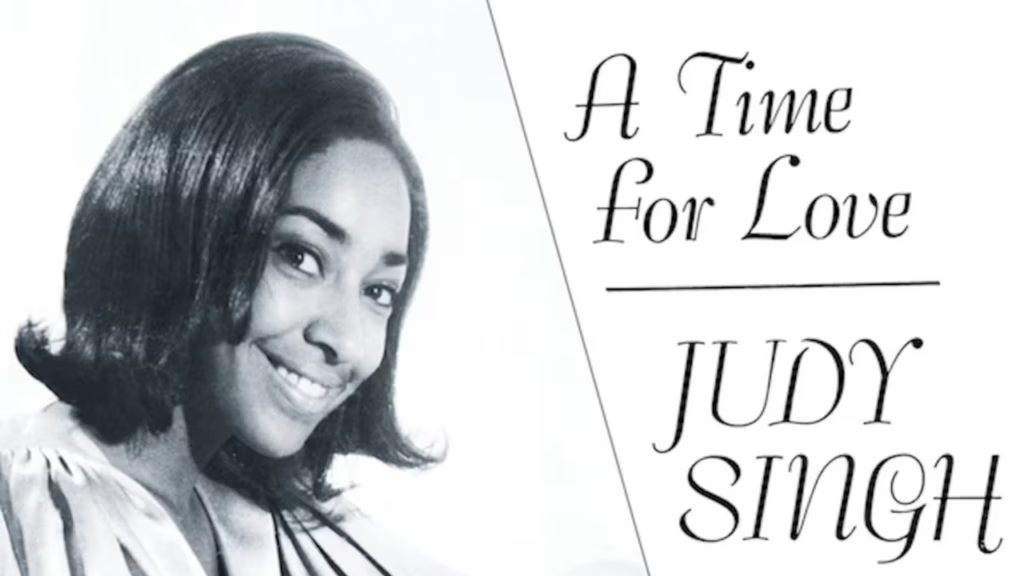
Judi Singh began making a name for herself as a teenager. She opened for Roy Orbison and made her debut at the Yardbird Suite at the age of 17. A few years later, she moved to Winnipeg to work at the CBC, and to Toronto, which had a larger and more active jazz scene. After returning to Edmonton in 1970, she recorded A Time for Love, an album that helped her establish a significant following in Western Canada. The great American trumpeter and bandleader Woody Shaw (1944-89) performed in Edmonton on several occasions. He heard Singh perform and was so impressed that he invited her to go to New York to work on his 1980 album For Sure!
Singh appears on two tracks of For Sure! On “Why?” by Shaw’s long-time drummer Victor Lewis, Singh’s vocals add an eerie texture to a mostly instrumental composition. Her major contribution to the album is her own composition, “Time is Right,” which has lyrics that appear autobiographical. Singh was never able to have the high-flying career she worked so hard to achieve. There were limited opportunities for women of color. Moreover, she faced difficult personal circumstances just as her career was taking off in the late 1960s. She fell in love with guitarist Lenny Breau (1941-84) while she was in Winnipeg and eventually had a daughter with him. Unfortunately, his struggles with drugs and alcohol got worse and worse. To provide a safe environment for her daughter, Singh decided to return to Edmonton, an isolated city that is far from North America’s big jazz scenes. Given these circumstances, the opportunity to record with Woody Shaw must have seemed euphoric. Here is an excerpt of the lyrics: “Sky is clear; we cried all our tears and we saved all our smiles for this moment. Time is right of us to take a flight to the land of ecstasy. We waited so long to sing you this song and we saved all our smiles for this moment.” In “Time is Right,” you can hear the traits that make her fans fall in love with her singing: her velvety voice, the effortless-sounding phrasing, the vocal control, the rhythmic flexibility, and her scat singing.
“Time is Right” cemented Singh’s reputation as an internation artist, and she continued to perform into the early 21st century. Unfortunately, she never got another big break after this recording.
Resources
- Andrew Jeffrey, “‘Why Did Edmonton Forget Judi Singh?’ Researcher Uncovers Story of Jazz Music and Alberta’s Roots.” CBC, February 19, 2021.
- Poushali Mitra, “Judi Singh: A Black & South Asian musician from 1950s-70s Edmonton.” Edmonton City as Museum Project, February 19, 2021.
- Baljit Sangra (director). Have You Heard Judi Singh? Knowledge Network, 2025.