
Asian America in 25 Songs
#19, Madame Gandhi, “Waiting for Me”
Historical Context | The Music | Resources
Historical Context
Gender is one of the most important analytical tools for understanding Asian American experiences. It affects community expectations, family decisions, economic well-being, intergenerational relations, and many other aspects of life. Gender is even the basis of many immigration laws and policies. The Page Act of 1875 was the United States’ first immigration restriction, and it effectively barred the entry of Chinese women on the belief that they were likely to work as prostitutes. During the Exclusion Era, the Japanese government made a deal with the U.S. government to establish the picture bride system, which ensured the sustainability of Japanese American communities. Over the past several decades, many immigrants—particularly women—arrive as the spouse of a visa or green card holder. Their ability to remain in the country often depends on staying married—a situation that can lead to abuse.
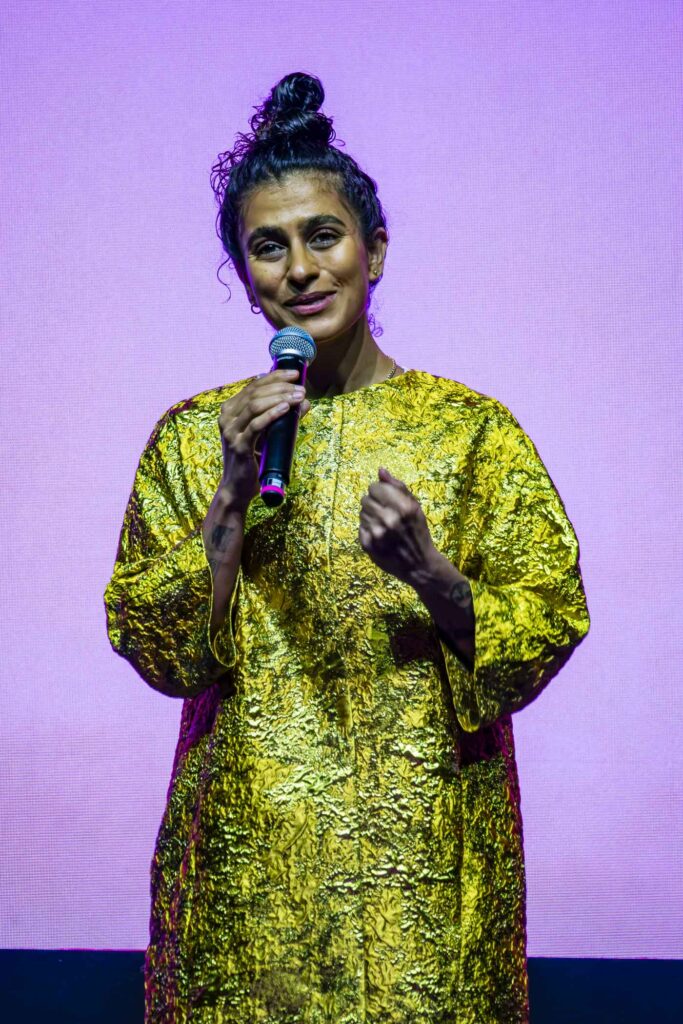
Madame Gandhi (b. 1989) is a Los Angeles-based producer, drummer, artist and activist. After establishing her career as a touring drummer for M.I.A., Thievery Corporation and Kehlani, she has focused on writing and performing music that fights for gender liberation and climate action. For Madame Gandhi, gender liberation means that there is no hierarchy associated with gender identity, and that identifying in a particular way does not give you access to any privilege. She furthermore believes that we need to fight for all types of oppression simultaneously, and that past feminisms’ “first us then you” mentality helped to perpetuate oppression.
Joyfulness and positivity are hallmarks of Madame Gandhi’s music. For her, these express her belief that something better than our current society is possible. At the 2021 Harvard Kennedy School Women in Power Conference, she said, “My truth in this moment is that when I listen to something uplifting and healing, it makes me feel good. So, that’s the kind of music I want to play for somebody else. And when I listen to music where somebody else is stepping into the fullness of their personal power, despite everything in society that holds us back, that is sexy to me. That turns me on. That makes me feel good.”
The Music
“Waiting for Me” is the opening track of Madame Gandhi’s second EP, Visions (2019), and the music video was released a year later. It presents two contrasting worlds. In the video’s opening, we see, according to Madame Gandhi, “images of jail-cell like bedrooms and learning institutions, robotic behaviors like shopping and flipping through the television, and constrictive uniforms that indoctrinate us as kids into systems of oppression.” It’s a repressive environment, but control is not total. Neon green socks, belts, ties, hairbows and monitors punctuate the scenes, suggesting that change is possible. As we watch, we hear Madame Gandhi intone, “We always assume our own powerlessness, but never our own power. Stigma is one of the most effective forms of oppression, because it denies us the vocabulary to talk comfortably and confidently about our own bodies.” In many ways, the school scenes in this opening depicts Madame Gandhi’s own experiences in private schools. In an interview with Platform magazine, she said, “Throughout my childhood, I always attended all-girls private schools. In NYC I attended The Chapin School, and in Mumbai, I attended St. Anne’s. I loved my time at both because it was so inspiring to be around other women and girls, and celebrate the space to be leaders without the more domineering energy of our male counterparts. But I also felt critical of how we as a society in general school our children to conform, to not question society, to not develop their own creative intuitions.”
As the video proceeds, the characters escape the buildings and run into nature, where they discover freedom. We see an intersectional group of femmes—each dressed uniquely but within a certain range—dancing joyfully and drumming in protest. About this setting, Madame Gandhi writes, “The forest world represents what it could look like if women, trans folks and gender nonconforming folks took control of our own learning and self expression and peacefully gather in order to re-imagine the world. This return to nature is a starting point for the new system of values that I believe we must incorporate in order to create a sustainable relationship with our Earth. The return to water is a symbolic metaphor for washing off the past and drinking in the future. The running imagery, referencing my 2015 menstrual marathon run from London, represents an act of personal freedom and liberation, both literally and metaphorically.”
Resources
- Nidhi Gupta, “Madame Gandhi’s ‘Waiting for Me’ Is the Art the World Needs Right Now.” GQ India, June 19, 2020.
- Max Freedman, “Madame Gandhi: On Seizing the Moment.” The Creative Independent, January 31, 2023.
- Madame Gandhi, “Madame Gandhi Releases Latest Music Video ‘Waiting For Me.’” Madame Gandhi Blog, June 30, 2020.
- Hansika Lohani Mehtani, “Madame Gandhi: Waiting for Me.” Platform, 2020.
- Two-Browngirls, “TBG x Madame Gandhi: On Being a Browngirl.” YouTube.